La Storia Antica del Messico by Francesco Saverio Clavigero Echegaray (1781)
By Quinn Erickson, Isa Sharfstein, and Champ Turner
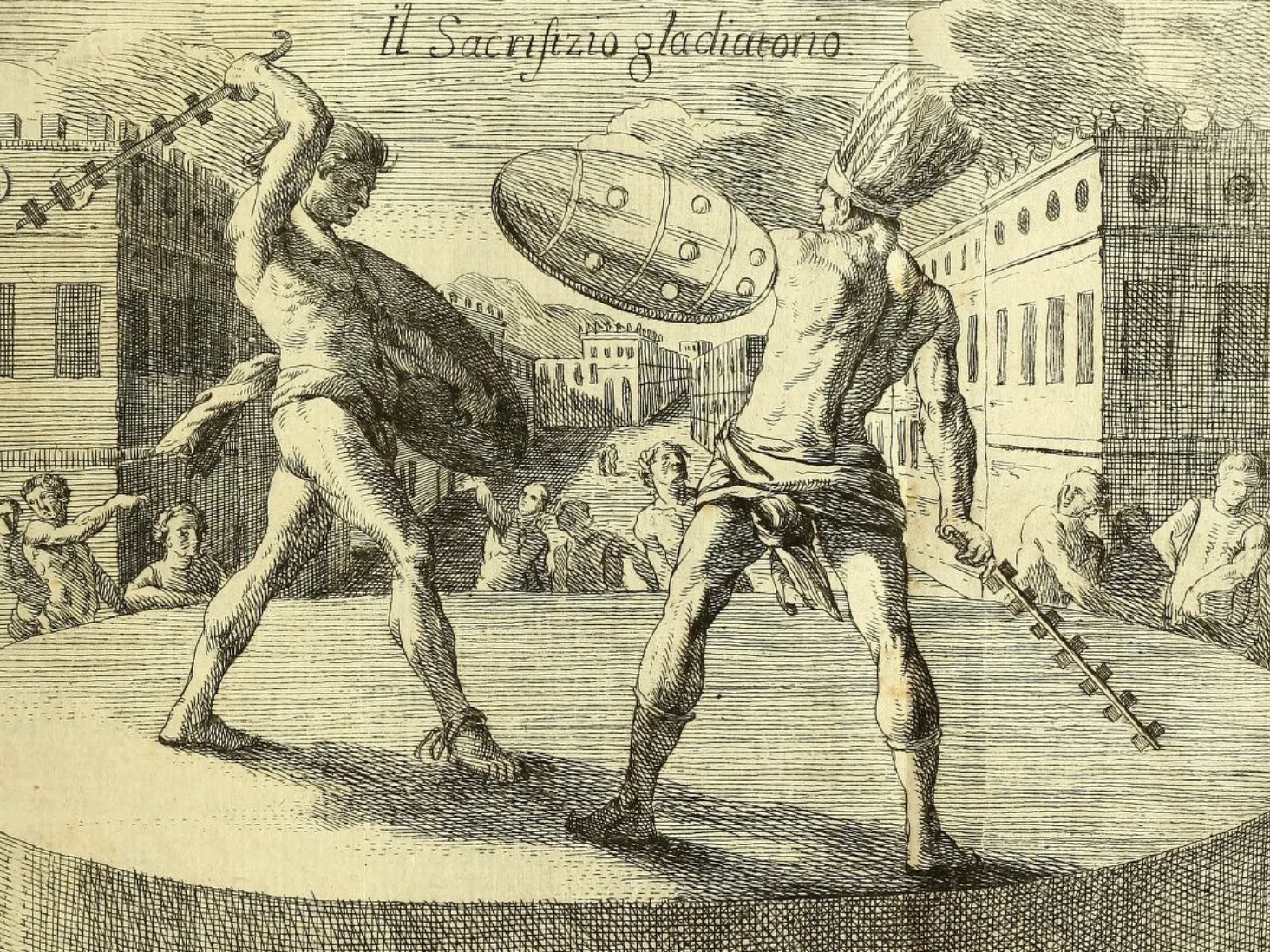
cover image: il Sacrifizio gladiatorio, Clavigero, Francesco Saverio, 1731-1787
Storia antica del Messico cavata da' migliori storici spagnuoli, e da' manoscritti, e dalle pitture antiche degl' Indiani ... Tomo II
Cesena; Per Gregorio Biasini all' Insegna di Pallade
B780 C617s / 1-SIZE
An Introduction to the Volume
La Storia Antica del Messico, published first 1781, offers an account of the history of Mexico — referred to in Nahuatl as the Anahuac, or core of the Aztec empire —through the lens of Mexican-born Jesuit Francesco Saverio Clavigero Echegaray. Born in 1731 to a creole mother and Spanish father, Clavigero lived, worked and studied in central Mexico, accessing many of the Nahuatl manuscripts in the region, until the expulsion of the Jesuits in 1767, when he relocated to Italy. There, he encountered an incredibly insular and polarized body of European writings on the Americas. These works were largely written by authors who themselves had never traveled to Spanish colonial provinces. These books and philosophical papers often reworked existing material — or simply fabricated information — for the sake of painting a more intense and exotic image of the Americas.
Clavigero composed his volume with the goal of dispelling these insular accounts of Mexican history with a more sympathetic history of the region and its people. Though he had set about composing his own history of Mexico due to restore truth to the false accounts that permeated the market, Clavigero sought to further argue the case for religious missions in the area, calling upon a falsified, cruel Mexica past that could only be corrected through the moral teachings of Christianity. Clavigero presents the Mexica people as a fascinating “other” reminiscent of past European societies. Upon publishing, Clavigero’s account became widely regarded as one of the most informed and complete sources on information regarding the Americas. This is suggested by its rapid translations from the original Italian edition — making the book accessible to a broader European intellectual market. Today, the John Carter Brown Library holds the Italian (1780), English (1787), and German (1789) volumes of The History of Mexico.
Indigenous Sources
Francesco Clavigero begins his book with a comprehensive bibliography of the sources which he consulted in the production of his History of Mexico. Beginning with “an account on the writers on the ancient history of Mexico,” he presents his sources based on the century in which they wrote and the religious and ethnic identity of the author. The first group of sources is largely composed of the writings of 16th century Spanish conquistadors, such as Hernán Cortés, and missionaries (primarily Franciscan and Jesuit), such as Fray Bernardino de Sahagún. The second group, introduced without any formal distinction, are numerous post-colonial Indigenous historians whose works Clavigero credits as invaluable to codifying an accurate pre-colonial history. While they come from many different Indigenous groups and geographic regions within Mexico, they are almost all identified by their noble status or descent from pre-colonial emperors. No doubt a product of access to resources and historical documents, it is also a way of legitimizing their individual contributions as part of a power structure familiar (and potentially comforting) to Clavigero’s audience. After this century- by-century account, he moves on to a section titled “On Paintings” which details some collections of pre-colonial manuscripts “saved from the burning of the first missionaries.” (Clavigero, 6). Having worked with the “collection of Siguenza” during his time studying at the college of San Pedro and San Pablo, he continuously suggests the value of these Aztec codices, particularly the “collection of Mendoza,” in the study of history. It’s a pointed statement against Cornelius de Pauw and other degeneracy theorists who Clavigero’s volume sought to disprove. Degeneracy theorists, who claimed that the Americas were home to weak, infertile native populations incapable of developing abstract ideas and were inferior to Europeans, had previously rebuked the Codex Mendoza as illegible and potentially fraudulent (Winterer, 84). Scholarship has shown Clavigero’s assessment of the codex to be accurate, establishing the Codex Mendoza as one of the most significant sources of information about the Aztecs thanks to its annals, tribute list, and commentary on the everyday life of the Mexica people.
Illustrations
The 20 plates which are featured in the book are said to be based on illustrations copied from “Mexican paintings” (ie. Aztec codices), alongside details from colonial documents and illustrations. The reuse of prints is perhaps clearest in the prints Clavigero used from the Nova Plantarum, published in 1651 (see the reused image of what is meant to be an axolotl in annotation 1 in Historia Antigua de Megico, taken from the Nova Plantarum). The Nova Plantarum was circulating for roughly 130 years prior to Clavigero’s book. While Clavigero was eagerly received as a contemporary perspective on Mexico informed by both European and Indigenous sources, it is important to note that he too relied on outdated colonial material in the construction of his arguments.
Translation and Differences in the Volumes
Though the manuscript was originally composed in Spanish, Clavigero, with the help of friends and peers, translated it into Italian for publishing in Cesena in 1780. Several years later, the Scottish scholar Charles Cullen translated the Italian edition into English. Cullen opens the book with a dedication to the 3rd Earl of Bute, John Stuart, whom he thanks for gifting him the original Italian edition and his continued patronage of the pursuit of knowledge. In his preface, he goes on to explain the importance of the book as a new and uniquely informed piece of historical writing within a stagnant Intellectual community, blinded by “Partiality, prejudice, ignorance, and credulity.” (Cullen, preface i). It is important to consider this addition not only in the context of a translators note, but also as a method of further establishing legitimacy to Clavigero’s proceeding arguments. A broad European readership had only encountered so much information regarding the Spanish Viceroyalties at the time, often diluted by inaccurate works written by those who believed in the inferiority of the American people or by those who had never even been to the Americas. In gaining further readership with the translated English edition, Clavigero’s goal of dispelling these insular accounts of Mexican history with a more sympathetic history of the region and its people could be realized.
The 1787 English edition also shows a marked modernization over the original Italian, which maintained a more traditional print aesthetic with narrow kerning, large typeface, and little spacing between lines. It is also ornamented with historiated initials (depicting pastoral, European-style landscapes) and stylized chapter opening and closing illustrations/typefaces. The English edition, in contrast, uses a minimalist approach- increasing the kerning and eschewing almost all ornament besides the illustrated plates which themselves appear subdivided and reduced in complexity. It is also split into two editions rather than one, focusing on legible presentation and marketability. This emphasizes an appeal to the modern, sophisticated viewer while easing the printing process as the popularity of the book exploded, becoming a critical piece of history writing particularly in the newly established United States.
Both publications feature a similar map of Anahuac, the historical homeland of the Aztecs and other Nahuatl-speaking groups that now constitutes central Mexico. In the English translation, the toponomy shows clearer visual hierarchy and is rendered in type, while the Italian version is hand-lettered and more cluttered. The map is embedded as a pullout in both copies (see the 1826 Italian edition’s map of central Mexico in annotation 2), after the preface in the Italian first Italian publication and before the title page in both the English version and the 1826 Italian reprint.
Flora and Fauna
La Storia Antica del Messico was authored and published with the intent of being the most complete and comprehensive history of Mexico to date. To foreground this history, Clavigero devotes the entire Book 1 of the volume to contextualizing the natural history of the region. An overview of geophysical observations and mineral resources segues into a description of native flora. In doing so, the author pays tribute to the 16th century naturalist Francisco Hernández de Toledo, who documented medicinal plants in the region for the Spanish crown, but Clavigero ultimately deems his catalogue too restrictive for his more comprehensive natural history (Cullen pp. 36). Clavigero thus begins the chapter with a description of flowers “worthy to be mentioned” (Cullen pp. 17) for their peculiarities, scents and beauty, not necessarily their instrumental value. Nonetheless, the subsequent descriptions of fruits, legumes, beans, peppers and grains (including many widely utilized native crops like cacao, peanuts, chili, vanilla, and maize) point out their specific uses by native peoples and, when appropriate, how they have been or could be adopted for European use. Whenever possible, Claviergo uses the native name to describe such species, with comparisons to better-known European and American varieties.
Native fauna is described similarly, with native names being employed in most cases with selected species being compared to European species and occasionally given names referencing non-native species (such as “Mexican tiger” for jaguar). Such attempts to convey physical traits in the absence of illustration can be comical at times: Clavigero describes how the tapir, a mid-sized ungulate, “approaches most to the sea-horse, not however in size, but in some of its shapes and qualities” (Cullen pp. 41). The dangers and benefits of species to humans are described where appropriate, but the majority of the descriptions are devoted to portraying the physical traits and behaviors of the animals represented. Clavigero extolls the beauty and power of many native species as a source of awe and pride.
The illustrations in this section are relatively sparse in relation to the volume of species described, with only a handful of plants and animals presented visually (see annotation 3). The engravings of the English translation are faithfully copied from the Italian (though with more detailed mark-making) and the English-version images appear vertically flipped as a result of engraving from the printed original-version images. The English version also features more plates with specimens more spread out.
People of Nature, Nature of People
Book 1 on natural history concludes by describing the physical characteristics and temperment of the of native population, which Clavigero ultimately suggests to be well-adapted to the environment. Though later chapters extensively treat the human history and ethnography of the Nahua peoples and Aztec Empire, this research is nonetheless contextualized as emerging from, not with nature, as was the predominant scriptural viewpoint that informed European attitudes towards colonization.
Disease is employed by Clavigero as a segue to bridge the non-human and human-centered sections of the first chapter, and informs his environmentally deterministic portrayal of native populations. The disparate impact of tropical diseases on native populations and European settlers contributed to this sort of deterministic view.
European Degeneracy Theory, as described in Julyan Peard’s Race, Place and Medicine, suggests that European bodies “degenerate” under exposure to “toxic tropical miasma,” and implied that, over time, the territory itself would have a “indigenizing” effect on colonists. Clavigero’s analysis of disease in Book 1 is indicative of this once commonly-held perspective.
Language
Clavigero, who spoke Nahuatl, the most common language in the region he identified as Anahuac, retained some of the original words for flora, fauna, places, and groups. Linguistic analyses of these words can reveal insights about Indigenous survivance through colonial necessity for new descriptors.
In researching flora and fauna in present-day Mexico, Clavigero’s conversations with Indigenous naturalists resulted in the preservation of Nahuatl words through the colonial text. The words used by the friar in describing marine and terrestrial animals were each adopted into one or more colonial languages, and represent associations between “exotic” wildlife and Indigenous land. Each stimulates the settler colonial imaginary — the plates and images even more so — and implies that mass land appropriation was needed for the physical domination of colonial powers over these fauna.
Many of the words describe “dangerous” animals, particularly fish, which can imply interesting things about the degree to which aquatic animals were more feared or “interesting” than land-borne ones, and more plentiful within the “New World.” More aquatic animals are described in the text, while most of the plates depict fully terrestrial (see annotation 4 for example) or amphibious creatures.
The Indigenous Population and the Colonial Obsession with Sacrifice
Representations of Aztec sacrifices were in pursuit of pathologizing it and its logics. Influenced by Clavigero’s positionally as a Jesuit priest, these images, including “A Common Sacrifice,” (see page 305) stimulate the settler colonial imaginary through moral and religious justification for intervention. They present a version of the Indigenous people of Anahuac that regularly engage in brutal violence, completely unaware of the violence that they were happily engaging in in the name of Christianity.
The emphasis on these sacrifices entailed two implications -- that settlers seeking to stop “cruelty” and “idolatry” could through violent means of their own and those seeking to “modernize” Indigenous peoples could through the violent means of religious colonial institutions.
Additionally, the Romanization of the Indigenous cities, people, and culture implies connotations of “ahistoricity” and “amodernity,” that the Mexica of the time were like the Romans of old, and thus could be hierarchalized as such within logics of “modern nationhood.” (See annotations 5 and 6).
The Aztec Lineage
In the latter chapters of the volume, Clavigero meticulously tracks the lineage of Aztec kings through wars, coups, and strife. The author pays particular attention to Montezuma Xocojotzin, or Montezuma II, the last Aztec king during the Spanish conquest led by Hernán Cortéz. The author emphasizes the ruler’s immense personal wealth, exotic audaciousness, and the gendered performance of strength. The end of Moctezuma II’s reign represents, for Clavigero, the key inflection point in Mexican history Discussion of his reign in such detail serves to link the pre-Hispanic history with post-conquest history, and appropriates this ancient lineage as a foundational link in the unifying “history of Mexico” which Clavigero seeks to construct. (The term “Aztec” did not come to be until a few decades after publication, and “Mexican” is Clavigero’s preferred term to describe the empire).
Reception and Ongoing Legacy
In his writing on the history of the Anahuac, Clavigero describes the Aztec Wanderings and the “classical” Toltec civilization– a group which he relates to the Ancient Greeks in European history. Here, he communicates an Indigenous oral tradition which claimed that the Toltec civilization migrated from a region north of Mexico into the Anahuac. 600 years later, in the twelfth century, he writes that the another group joins them from the north — the Aztecs.
Upon publishing, it was this claim which gained particular attention from American scholars, anthropologists, and politicians. A theorist by the name Benjamin Smith Barton was the first to connect the Toltec migration myth to the mounds of the Mississippi River Valley. While the mounds of the Mississippi River Valley were recognized as complex cultural productions within the frame of Western empire, Barton, alongside other American scholars, tied these mounds to the Aztec temples of central America, claiming the Toltecs as common progenitors and thereby alienating Indigenous populations of the trans-Appalachia West from this history. “Disconnected from the mounds, they remained mired in barbarity, and might be treated accordingly.” (Winterer, 96) Thomas Jefferson took an interest in the work of Clavigero for this specific reason. Having purchased La Storia Antica del Messico in its original Italian during his time in Paris from 1784-89, he was similarly frustrated with the distant European theorists and quick to support Clavigero’s history. He subsequently joined the new mound-building theorists, using it to justify the colonial expansion of the United States into Indigenous territories. By the mid 19th century, this had become a dogma for anthropologists of North America and played a critical role in justifying the North American Indian Removal period. Clavigero may not have anticipated it, but he provided them with material and legitimacy to make this claim (Winterer, 88-99).
Bibliography
Alba-Koch, B. (2005). Providence, Indigenous Protagonism, and Enlightenment: Clavijero’s Rendition of the Conquest of México. Lumen, 24, 49–63. https://doi.org/10.7202/1012174ar
Clavigero, Francesco Saverio, 1731-1787, “Storia antigua de Megico,” London, England: Lo Publica R. Ackermann, Strand, Y En Su Establecimiento En Megico: Asimismo En Colombia, En Buenos Ayres, Chile, Peru, Y Guatemala: 1826.
“Codex Coyoacan, Scene of Chichimeca.” VistasGallery. Accessed May 13, 2022. https://vistasgallery.ace.fordham.edu/items/show/1685.
“Tepexozuca, Manuscrito Techialoyan De.” Tepexozuca, Manuscrito Techialoyan de | The Mapas Project. Accessed May 13, 2022. https://mapas.uoregon.edu/tepex.
Winterer, Caroline. “The Civilization of the Aztecs.” American Enlightenments: Pursuing Happiness in the Age of Reason, Yale University Press, 2016. ProQuest Ebook Central, https://ebookcentral-proquest-com.revproxy.brown.edu/lib/brown/detail.action?docID=4699848.
Editorial Note
Edited and Adapted for Americana by Rachel Moss.
This essay and the related annotations belong to the student-led project Illustrating Knowledge of the Americas in European Print, 1590–1781. Learn more at the project homepage: https://americana.jcblibrary.org/Illustrating_Knowledge/
Project Creator(s)
- Rachel Moss
- Michal Loren
- Emily Monty
- The John Carter Brown Library