Nova Plantarum, or the Tesoro Messicano by Francisco Hernández (1651)
By Michal Loren and Dawson Phillips
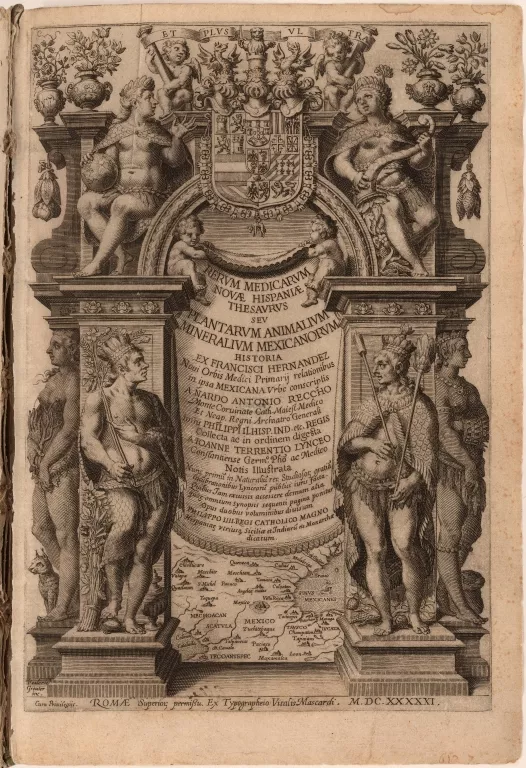
cover image: [Title page] Rerum medicarum Novae Hispaniae thesaurus, Frederic Greuter for Hernandez, Francisco, 1517-1587
Novum plantarum, animalium et mineralium mexicanorum historia
Rome; Sumptibus Blasij Deuersini, & Zanobij Masotti Bibliopolarum. Typis Vitalis Mascardi
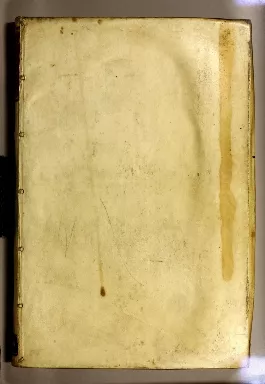
B651 H557n / 2-SIZE
Overview
The Rerum medicarum Novae Hispaniae thesaurus (1651), also titled Nova plantarum, animalium et mineralium Mexicanorum historia, is a massive volume, over 1000 pages long and containing hundreds of woodcut images. It was originally written by Francisco Hernández (1517-1587), the physician to King Philip II of Spain, who spent seven years in Mexico cataloging its flora and fauna. He commissioned Indigenous Nahua artists and experts to paint natural specimens which are the roots of the book’s images. Eventually, the book was published in 1651 with extensive commentary by naturalists in Rome, the men of the scientific and princely Accademia dei Lincei.
Background and Timeline of Publication
By the 16th century, European powers already possessed a substantial amount of information concerning American plants and spices, and had established an extensive trade network of medicinal herbs. During this time, there was an intense desire to expand Europe’s depth of knowledge concerning American resources in order to fuel developing colonial markets. King Philip II of Spain took advantage of the want for a naturalist guide of the Americas: he asked his physician, Francisco Hernández, to research the uses and cultivation of so-called New World plants and animals. This pursuit of naturalist knowledge was driven by a desire to dominate the global trade market, which informed the type of knowledge Hernández documented and influenced the information available to the many other contributors of the Nova Plantarum.
1570: Royal physician Francisco Hernández departed from Spain under orders from King Philip II, who hoped to gain knowledge of medicinal plants to be exploited by Spain. Along his expedition, Hernández commissioned Indigenous Mexicans knowledgeable in American flora and fauna and Indigenous artists to gather specimens, create illustrations, and provide knowledge of the uses of native plants and animals. While Hernández’s notes were focused mainly on describing flora and fauna within the context of scientific classification, his letters to Philip describe immense natural resources, bountiful enough to supply the entire world with medicine and lend the king international fame.
1576: After extensive revision and experimentation, Hernández completed his work and forwarded all 16 manuscripts written in Spanish, Latin, and Nahuatl to King Philip II along with dried specimens and drawings of plants and animals made by Indigenous artists. The manuscripts were bound and stored in the monastery-palace of El Escorial in Madrid until they were destroyed by a fire in 1671 .
1580: Due to the extensive, unstructured nature of Hernández’s original manuscripts, King Philip assigned another physician, Nardo Antonio Recchi, to create a volume of Hernández’s manuscripts to be published along with illustrations for easier use by scholars. Recchi’s manuscript was completed in 1582. It included an abridged version of Hernández’s text, as well as commentary made by Recchi and copies of the images in Hernández’s manuscripts.
1589: A copy of Recchi’s work was transferred to Naples along with the author himself. Following Recchi’s death, his original manuscript was passed to his nephew, Marco Antonio Petilio.
1611: Italian prince Federico Cesi, who, along with Johannes Eck, founded the elite scientific society the Accademia dei Lincei in 1603, bought Recchi’s text from Petilio and began working on its publication. Recchi assigned Johannes Schreck, a Lincean scholar known for his expertise in language and medicine, to compile and comment on Recchi’s work. By 1612, the pilot version was nearly finished. However, before it could be published, Schreck left the Accademia to become a Jesuit missionary in China. Cesi then decided to add additional commentary, assigning the task to Johannes Faber and Fabio Colonna. Cesi divides the four books in Recchi’s original manuscript into ten.
1615: A Spanish translation of Recchi’s selections of Hernández’s work, edited by Francisco Ximénez, is published in Mexico under the title Quatro libros de la naturaleza, y virtudes de las plantas, y animales que están recevídos en el uso de Medicina en la Nueva España. This is the first publication of Recchi’s full manuscript.
1625: Johannes Faber completes comments on 35 images of Mexican animals, contributing 400 pages. Three years later, Fabio Colonna finishes integrating Schreck’s comments, completing his Annotationes et Additiones.
1628: The Nova Plantarum is printed in Rome in separate issues, but it is not published as a whole because Cesi’s Tabulae Phytosophicae, an extensive summary of botanical organization, was not yet finalized. In 1630, Cesi died, leaving his Tabulae incomplete. After Cesi’s death, Francesco Stelluti led the printing of the Nova Plantarum along with Fabio Colonna.
1648-9: German artist Johann Freidrich Greuter completed two elaborate frontispieces for the final Lincean edition.
1651: The first edition of the Nova Plantarum, animalium et mineralium Mexicanorum historia is printed and published in Rome by Vitalis Mascardi.

Francisco Hernández e.a.
Quatro libros. De la naturaleza, y virtudes de las plantas, y animales q...
1615
What is the Nova Plantarum?
As a book, the Nova Plantarum mediates between Spanish invaders and the various Indigenous cultures of Mexico. It is a textual vehicle through which the Spanish exerted their power. Hernández, a physician interested in natural history, did some of his own research in the seven years he spent in Mexico, experimenting with its plants and dissecting the bodies of Indigenous people that died of the plague brought by the Spanish invasion. The Nova Plantarum must therefore be read in the violence of its colonial context. The knowledge that men like Hernández, Recchi, and the other Linceans claim authorship over was largely not theirs.
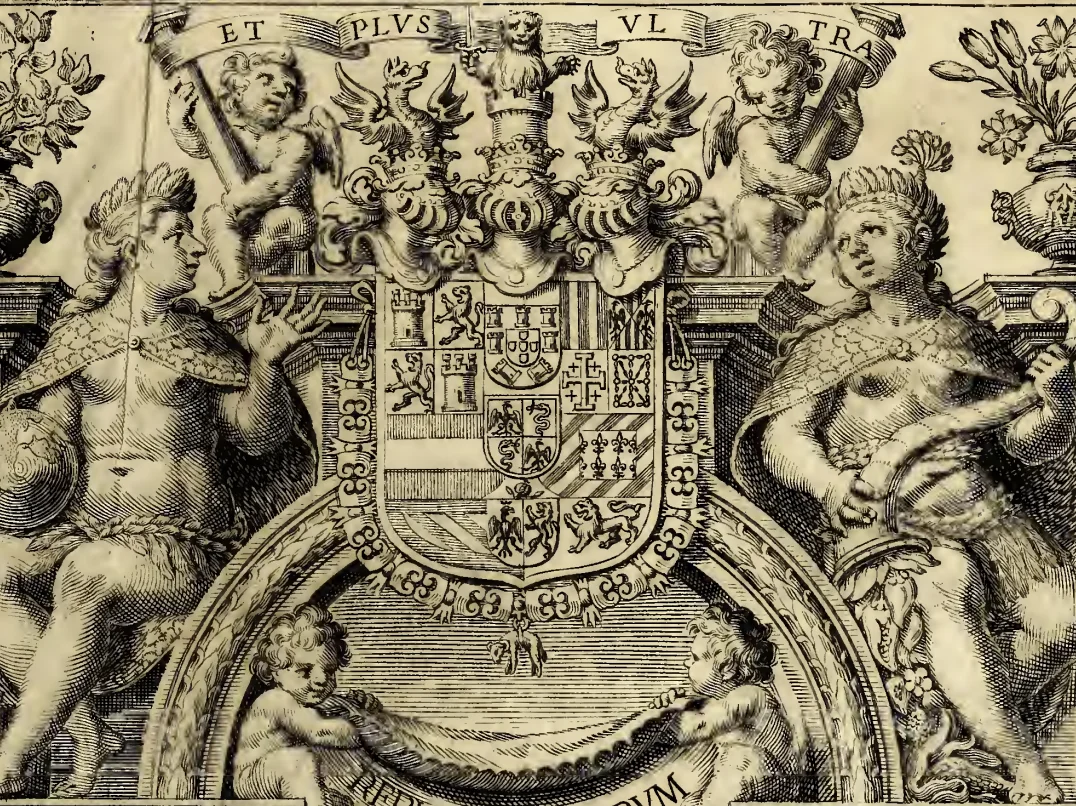
The Accademia dei Lincei gave the volume two title pages, owing to the monumental nature of the work and its long print history. The first title page, perhaps the most famous page of the entire book, is a busy and ornate depiction of Spanish domination over American abundance. See the annotations for a deep dive into the significance of the imagery on this page.
The text itself is a layered compendium of natural knowledge. Each encyclopedia entry includes an image of a plant or animal, its name first in Nahuatl then in Latin, Hernández’s Latin writing detailing its uses, and occasionally a (usually brief) Latin commentary written decades later by Johannes Faber, one of the men of the Lincei. See the annotations for an exploration of one of these entries: the shining sumac.
The printed images were designed by the Lincei and modeled after paintings by Nahua people that Hernández commissioned while in Mexico. That the name of the organism is always listed first in Nahuatl then in Latin suggests Hernández’s acknowledgement of, if not respect for, the Native origins of much of the knowledge contained in his text. Because of this, the Nova Plantarum served, and continues to serve, as one of the largest extant repositories of Nahuatl plant and animal vocabulary. Yet the images always depict Mexican flora and fauna out of their native environments – decontextualized to fit the popular European genre of the encyclopedia. Thus, the Native painters of these images were putting their expertise toward a European project and a European understanding of nature.

Contributions to European Knowledge
At the time of its publication in 1651, the Nova Plantarum was considered the largest print natural history of the Americas. The systematic combination of images and text by the Accademia dei Lincei into one volume made it the first European encyclopedia of the natural world of the Americas. It was even more valuable because of its detailed morphological classification and cross-referencing to European species.
The book’s focus on plants and animals that would serve an economic purpose for Europe guided Hernández’s research and, later, the academic efforts of Nardo Antonio Recchi and the Lincean scholars. Federico Cesi and the Accademia dei Lincei paid special attention to the distinguishing characteristics of American flora and fauna in order to classify their morphology and medicinal uses most accurately. The result of their efforts is an extensive visual catalog that became foundational to European study of the Americas. Plants that served a marketable purpose received the most attention. One such plant is tobacco, explored further below. Readers will notice throughout the book how plants of particular use to European powers were described in vivid detail, whereas less economically useful plants received less commentary.
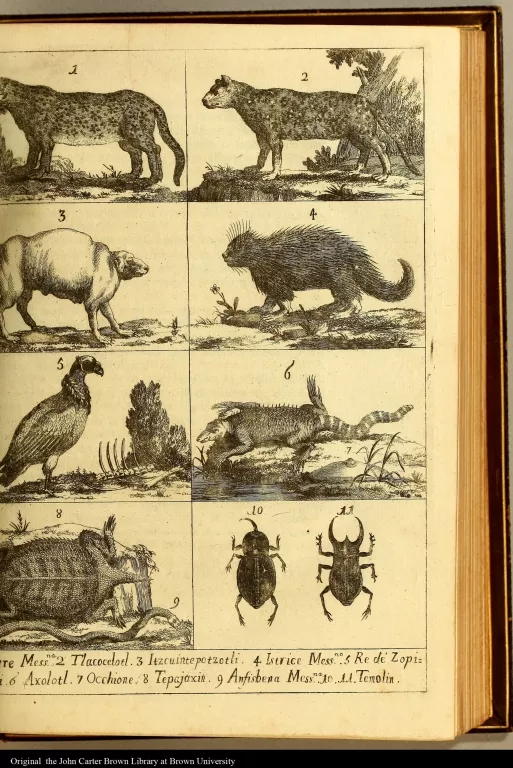
Because such an extensively detailed encyclopedia was so rare at the time, the woodcuts used in the Nova Plantarum were often reused by publishers or replicated by other artists in their depiction of the New World. For example, Francisco Clavigero’s Storia antica del Messico (History of Mexico) (1780-81) uses the same image of an iguana to represent an axolotl that first appears in the Nova Plantarum, over 100 years after the Nova Plantarum’s publication. While many natural histories and travel narratives at the time struggled to differentiate lizards from salamanders, this is a particularly egregious error not otherwise found in texts that discuss the axolotl without the Nova Plantarum’s woodcut image. This is just one of many examples of how other books printed after the Nova Plantarum recycled its images. In this way, one of Hernández’s most valuable contributions to early modern European culture was his rich visual depictions of the natural world of the Americas.
Another aspect of the Nova Plantarum that contributed to its value to European scholars was the use of Indigenous sources and incorporation of Nahuatl names into its categorization of plants and animals. Hernández’s collaboration with Indigenous artists and scholars expanded Western understanding of the Americas and provided Europe with insight into the uses of North American plants in particular. In addition to knowledge of the natural world, the Nova Plantarum includes a Nahuatl-Latin glossary, which has been credited with improving European understanding of Nahua language and culture. While the Nova Plantarum presents its information as neutral, objective fact, its use of Indigenous knowledge was in many ways a violent act. Expanding this information to a Western audience fueled European imperialism in the Americas through encouraging further exploration and exploitation of resources, thus contributing to the ongoing erasure of Indigenous peoples, in this case of Mexico, and their ways of knowing.

[De Pycielt, seu Tabaco.]
1651-1700
Francisco Hernández, and others
Nova plantarum, animalium et mineralium Mexicanorum historia
1651-1649
Print, Elites, and the Imperial Project
The long print history of the Nova Plantarum gives us a glimpse into the evolution of European views of Indigenous American peoples and cultures throughout the 16th and 17th centuries. When Hernández returned from Mexico in 1577 with sixteen handwritten manuscripts, not only did Spanish king Philip II bar him from publication (the text was overwhelming and disorganized), he ostracized him. Philip was concerned that, by including Nahuatl names for the organisms and using Native-painted images, the book was allegedly too sympathetic to the Indigenous peoples of Mexico. When the Nova Plantarum was finally printed in 1651, the Spanish were at the peak of their imperial power in the Americas. King Philip IV, to whom the book was dedicated, was also called Rey Planeto, King of the Planet, showing the global dominance of the Spanish colonial project. Only when Spain had fully consolidated its power over Indigenous Mexico could the Nova Plantarum, a book that acknowledged the presence of Indigenous knowledge, and therefore its bearers, appear in full.
But pieces of what would become the Nova Plantarum had already been circulating for decades among European elites. When Philip II gave Hernández’s manuscripts to Nardo Antonio Recchi for editing, those manuscripts included hundreds of paintings by Nahua artists employed by Hernández. Recchi brought the manuscripts to Naples in the 1580s and, by 1610, prints based on the paintings had begun to circulate among elite circles of prince-scientists. For example, the Historia naturae maxime peregrinae by Juan Eusebio Nieremberg (1635) contains many prints based on the Nahua drawings that Hernández commissioned that later made their way into the Nova Plantarum. Just one example of this is an image of what is now called the Mexican hairy dwarf porcupine, first printed in Nieremberg’s book, then in Hernández’s, and later in Clavigero’s. For more on this, see the annotations.
The circulation of these images suggests that European elites, particularly outside of Spain, were able to interact with Hernández’s “sympathetic” text because their sociopolitical status protected them from concerns about proximity to Indigenous knowledge. Moreover, and perhaps more importantly, Hernández’s work was famous even before the Nova Plantarum was published. These Spanish and Italian elites were explicitly interested in what the Americas could offer natural historical knowledge.
Juan Eusebio Nieremberg, and others
Ioannis Eusebii Nierembergii Madritensis ex Societate Iesu ... historia ...
1635
Indigeneity and the Monstrous
In 16th- and 17th-century Europe, fascination with marvelous objects and beings was an increasingly valued aspect of natural history. Colonialism and “discovery” of the Americas were fundamental in this process – the violent incorporation of new plants, animals, things, and people into western European culture evoked simultaneous wonder and horror. We can see this in the Nova Plantarum, where only about 400 of the book’s 1000+ pages contain Hernández’s original Mexican materials. The rest is commentary, indices, and botanical tables made by members of the Accademia dei Lincei, aiming to organize and structure scientific knowledge, to create order out of chaos, or monstrosity.
The copious 400-page commentary on the Nova Plantarum by Johannes Faber, one of the Lincei, includes not only more images of Mexican animals based on Hernández’s commissions but also images of anomalous creatures who did not necessarily come from the Americas. For examples of images like this, see Nova Plantarum annotations 12-14, on Federico Cesi’s two-headed calf, the mythical two-headed amphisbaena, and Cardinal Francesco Barberini’s mummified dragon.
The men of the Accademia dei Lincei drew a connection between these “monstrous,” marvelous, or deformed creatures and the Mexican plants and animals that Hernández wrote about using the labor of Indigenous experts and artists. European naturalists and nobles kept atypical creatures, like those with two heads, in their museum-like collections that often also contained Indigenous American artifacts such as clothing, plant, and animal specimens. The Lincei were not the first (and would hardly be the last) to connect Indigenous knowledge and monstrous beings, but seeing strange scientific curiosities right next to Hernández’s text from 70 years earlier emphasizes a specific European perspective toward the Indigenous peoples of the Americas pervasive in the 17th century: one of wonder, curiosity, and horror. This view constructed Indigenous groups like the Nahua as a cultural other, with the critical caveat that the knowledge contained in the book originated as theirs — a tension and a violence that persists today.
Bibliography
Bleichmar, Daniela. “Rewriting the Book of Nature.” In Visual Voyages: Images of Latin American Nature from Columbus to Darwin, 1-43. New Haven: Yale University Press in association with The Huntington Library, Art Collections, and Botanical Gardens, 2017.
Daston, Lorraine, and Katharine Park. Wonders and the Order of Nature, 1150-1750. New York: Zone Books, 1998.
Freedberg, David. “The Mexican Treasury: Taxonomy and Illustration.” In The Eye of the Lynx: Galileo, His Friends, and the Beginnings of Modern Natural History, 247-274. Chicago: The University of Chicago Press, 2002.
Goodman, David. “Philip II’s Patronage of Science and Engineering.” The British Journal for the History of Science, vol. 16, no. 1, [Cambridge University Press, The British Society for the History of Science], 1983: 49–66, http://www.jstor.org/stable/4026093.
Guerrini, Luigi. “The ‘Accademia dei Lincei’ and the New World.” Max Planck Institute for the History of Science, Preprint 348 (2008): 1-34.
Hernández, Francisco. Letter to Philip II. In Colección de documentos inéditos para la historia de España, vol. 1, 362-379. Madrid, 1842.
Kimmerer, Robin Wall. Braiding Sweetgrass. First edition. Minneapolis, Minnesota: Milkweed Editions, 2013.
López Piñero, José María. El códice Pomar (ca. 1590), el interés de Felipe II por la historia natural y la expedición Hernández a América. Valencia, Spain: Instituto de Estudios Documentales e Históricos sobre la Ciencia, 1991.
López Piñero, José M. and José Pardo Tomás, “The Contribution of Hernández to European Botany and Materia Medica.” In Searching for the Secrets of Nature: the Life and Works of Dr. Francisco Hernández, edited by Simon Varey, Rafael Chabrán, and Dora B. Weiner, 122-137. Stanford: Stanford University Press, 2000.
Neri, Janice. The Insect and the Image: Visualizing Nature in Early Modern Europe, 1500-1700. University of Minnesota Press, 2011. http://www.jstor.org/stable/10.5749/j.cttts5g8.
Varey, Simon, and Rafael Chabrán. “Medical Natural History in the Renaissance: The Strange Case of Francisco Hernández.” Huntington Library Quarterly 57, no. 2 (1994): 125–51. https://doi.org/10.2307/3817754.
Weiner, Dora B. “The World of Dr. Francisco Hernández.” In Searching for the Secrets of Nature: the Life and Works of Dr. Francisco Hernández, edited by Simon Varey, Rafael Chabrán, and Dora B. Weiner, 3-11. Stanford: Stanford University Press, 2000.
Online sources:
“[De Copalliquahuitl Patlahoac, seu Arbore Copalli latifolia, Copallifera II.]” John Carter Brown Library, accessed March 18, 2022. https://jcb.lunaimaging.com/luna/servlet/s/st7if3.
“Rhus copallinum L.” Native American Ethnobotany Database. Edited by Daniel Moerman. University of Michigan-Dearborn, accessed March 18, 2022. http://naeb.brit.org/uses/species/3345/.
Editorial Note
Edited and Adapted for Americana by Michal Loren.
This essay and the related annotations belong to the student-led project Illustrating Knowledge of the Americas in European Print, 1590–1781. Learn more at the project homepage: https://americana.jcblibrary.org/Illustrating_Knowledge/
Project Creator(s)
- Michal Loren
- Rachel Moss
- Emily Monty
- The John Carter Brown Library