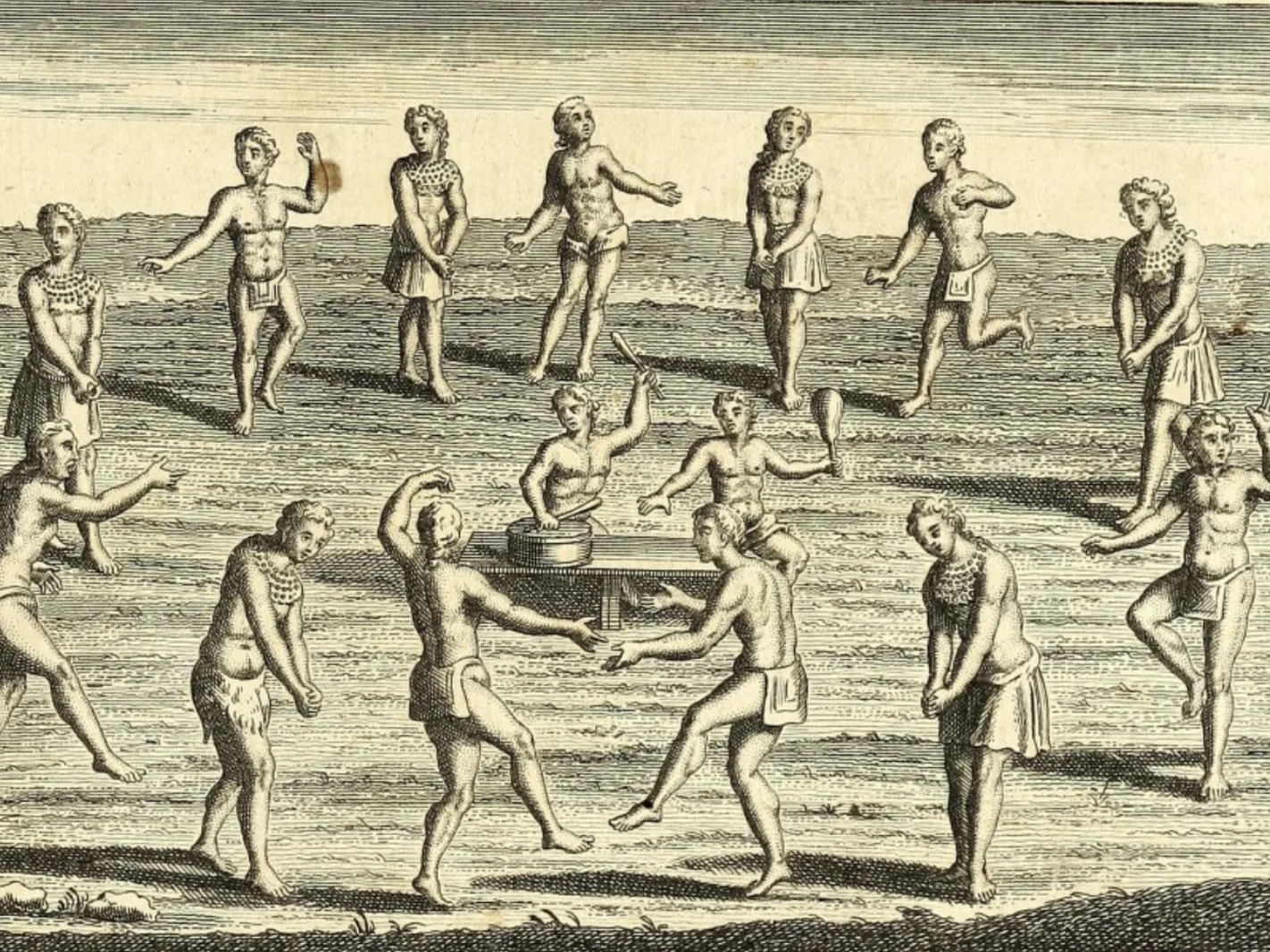
Mœurs des Sauvages Ameriquains, comparées aux mœurs des premiers temps (1724), Joseph-François Lafitau
By Zoe Zimmermann, George Nickoll, and Anika Bahl
cover image: [Planche XVIII pag. 522. [sic] Danses Iroquoies, appellées Te-Iennonniakoua & de l’Athonront, expliquées à la page qui y répond, Lafitau, Joseph François, 1681-1746
Moeurs des sauvages ameriquains, comparées aux moeurs des premiers temps ... Tome second
Paris; Chez Saugrain l'aîné, Quay des Augustins ... Charles Estienne Hochereau, à l'entrée du Quay des Augustins
E724 L164ml vol. 2 [R]
Introduction
Mœurs des sauvages ameriquains, comparées aux mœurs des premiers temps (1724), was written by Joseph-François Lafitau, a Jesuit missionary to what is now Canada who lived among the Haudenosaunee people, called the Iroquois by the French. When he wrote, Europe was very much still trying to grapple with the reality of entire societies that they had not previously encountered in the Americas. Although many of Lafitau’s peers at the time wrote of the native people they encountered in the Americas as a fundamentally different and savage race, Lafitau’s work presents them differently. As a high-ranking missionary of the Jesuit order, Lafitau had a vested interest in using his time in the New World to justify more missions there. As such, he set out to write Mœurs des sauvages ameriquains with three arguments: all the peoples of the world shared a common origin as asserted the the Bible’s Genesis chapter, all the religions of the world shared a common, pure origin which was eventually corrupted in different ways, and that, in a reciprocal relationship, Europeans could look to natives as an example of how their ancestors once lived and natives could look to Europeans as an example of what they can become. The use of the word “sauvages” in the title is intentional; although other words commonly used to describe Indigenous peoples such as “Indians” or “barbarians” could be traced back to refer to groups that do not share one’s background/culture, “savages” usually referred to groups that were generally “uncivilized.” Lafitau’s argument relied on this central point — according to him, the Indigenous peoples of the Americas did in fact share a heritage with Europeans, and it was just their uncivilized behaviors that needed to be remedied. While these arguments served to fuel the oppression of native peoples as much as many of the other kinds of arguments made in texts published during the same period, they meant that Indigenous communities were depicted as less primitive and more akin to Europeans. This provides an interesting lens through which to view the illustrations in the novel, especially those related to disciplines considered valuable to Europeans, such as religion, crafts, and warfare. Even so, despite the artistic care that Lafitau’s illustrator takes to depict native Americans as close counterparts to continental Europeans, Lafitau’s book remains ultimately an imperialist construction, solidifying the misrepresentation of Indigenous Americans that we see in largely every text of the time.
Joseph-François Lafitau, and others
Mœurs des sauvages ameriquains, comparées aux mœurs des premiers temps.
1724, v.1
Religious Parallels: The Iroquois and Greco-Roman Christianity
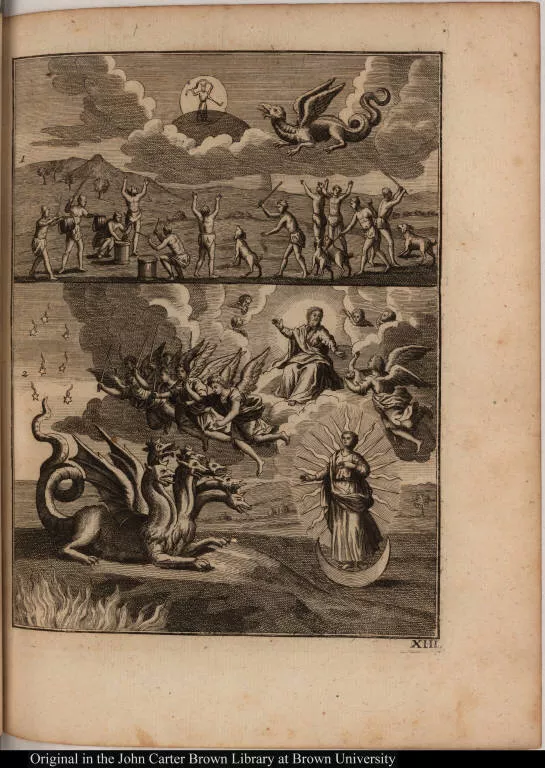
European entanglements with the Americas challenged many fundamental beliefs of Western Christianity. Before 1492, the European imagination of the world stretched only so far as Fisterra, the westernmost point of Spain. Suddenly, there was an entirely new geographical history to be stitched into the seemingly cemented dogmas of their religious belief. According to contemporary Christian interpretations of Genesis, all of humanity descended from Shem, Ham, and Japhet, the three sons of Noah. Did the discovery of an entirely new group of people, existing across thousands of miles of ocean, with entirely separate spiritual understandings of their own, challenge the claims of Genesis? Could all people, even those Indigenous to the foreign Americas, stem from Adam and Eve?
Certain European thinkers like the German Protestant physician-philosopher Paracelsus believed that Native Americans stemmed from a separate creation, while others upheld the longstanding belief that all humanity came from a universal religious origin. In his 350-page exploration of Native religious practice and belief, Joseph-François Lafitau tried to prove that all humans and their spiritual beliefs derived from one singular and natural religion of man. Through comparing his insight into Iroquois practice with his studies of Classical and ancient Christian texts, Lafitau argued that all of humanity stemmed from the same seed.
While we cannot ignore the harm Lafitau’s methods, and the Jesuit missionary project, caused, it must also be noted that his ethnographic account of Native Americans took an arguably more favorable view than the narratives spun by his predecessors and many who followed later. It was only the century before during which Spanish theologian Juan de Sepúlveda argued that the Native Americas were “natural slaves” in the Valladolid debate against the Dominican friar Bartolomé de Las Casas. Even the later construction of “noble savages” painted an image of the Indigenous as lawless, without clothes, without property, without ideology, and without religion. Regardless of his missionary ambitions, Lafitau’s first-hand study and account of Native religious belief gave more autonomy to the Iroquois than was standard for previous expeditions. To define their culture, regardless of the motivation, was to define the Indigenous as human, which, for the time, was not the standard.
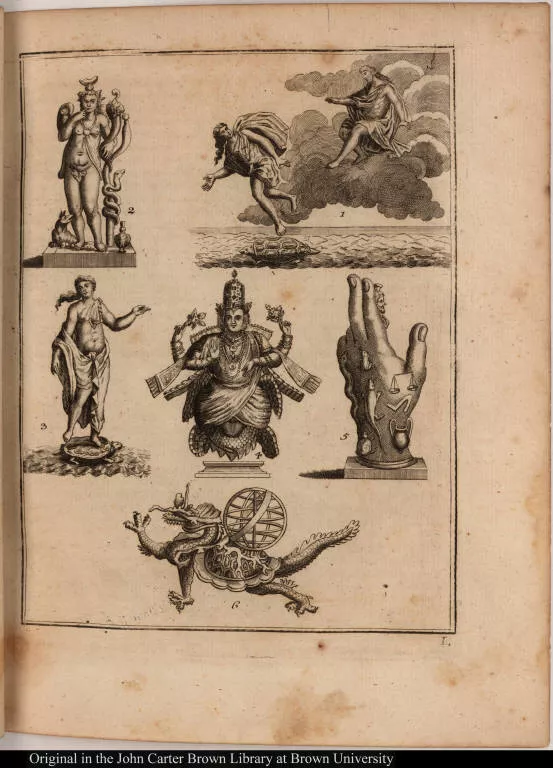
What were Lafitau’s motivations for comparing the religions of his forefathers and the Iroquois people? His goal in writing about their spiritual practice was to uphold the tenets of Genesis, to prove not only a singular and natural religion of humankind, but to also prove an evolutionary ladder on which civilizations were dispersed. For example, on page 94, Lafitau’s illustrator cross-references the common turtle back creation story with ancient religions previously known to Europeans: ancient Greeks and Romans, ancient Egyptians, Hinduism, and ancient Chinese spirituality. In this Native creation myth, a woman falls from the sky into a river and is brought back to the surface on the back of a turtle. That turtle became what many of us now know as North America, what many Native people today call Turtle Island. This story is presented alongside images from these other religions that include turtles as symbols. Through this comparison, this print suggests that Iroquois religion was connected to other ancient world religions, supporting Lafitau’s argument that all humankind originally shared a universal faith. However, in the text itself, Lafitau goes on to discredit the validity of the Indigenous turtle back story, promoting the biblical creation story, and thus his Jesuit mission, instead.
In essence, then, Lafitau claims that Europeans have climbed further up the same evolutionary ladder than the Iroquois. Although Lafitau may not be arguing for the complete and utter genocidal subjugation of the Native Americans, he does leverage religion as a way to argue European superiority, and therefore European duty to spread the (in his opinion) more advanced and precise views of the Jesuit faith.
Crafts and Material Knowledge
While religion was at the fore of Lafitau’s argument for universalism, he knew that he needed evidence reaching beyond religious beliefs. To do this, he devoted several chapters to describing the lifeways and material practices of Indigenous communities across the Americas. Unfortunately for modern historians trying to understand early modern Indigenous cultures, he was chiefly concerned with painting Indigenous knowledge as simply a “primitive” version of Western science, comparing them to ancient European societies at every turn and homogenizing indigeniety in the process. This section tackles Lafitau’s methods and motivations for this using three examples of how he describes Indigenous crafting and material knowledge: music, maple syrup, and ships.
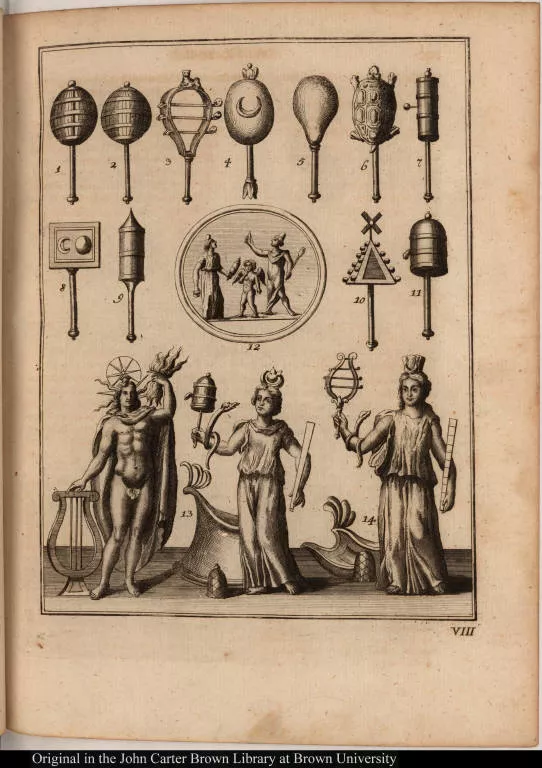
Lafitau posited that the instruments used by the many Indigenous peoples across the Americas, such as the maraca, the clatra, the astaouen, and the chichikoué, were slightly altered versions of the instruments that were used in ancient Europe. Classical European figures are illustrated at the bottom of the image. Notably, Indigenous musicians do not appear – only drawings of their instruments are represented. This dehumanizes the Indigenous communities who constructed such instruments, indicating to the reader that the evidence allegedly connecting them to ancient Europeans – and erasing their own cultures – is more important than the people themselves.
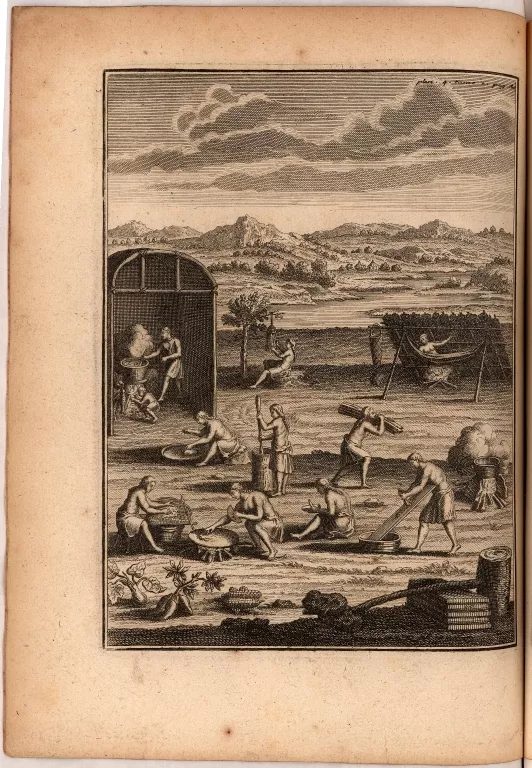
The Moeurs des sauvages Amerquains also illustrates the process undertaken by the Iroquois people to produce maple syrup. The Iroquois were, in fact, the only Indigenous community with whom Lafitau had first-hand experience, as he lived among them for five years. But his colonialist attitude pervades this imagery. He describes the maple syrup-making process in order to demonstrate that Indigenous knowledge rivals that of ancient European societies, and he compares the process of making maple syrup to the process of making wine. While praising them for their ingenuity, Lafitau is careful to maintain Indigenous inferiority to Europeans, writing that “the French do it better than the savages they learned how to do it from.”
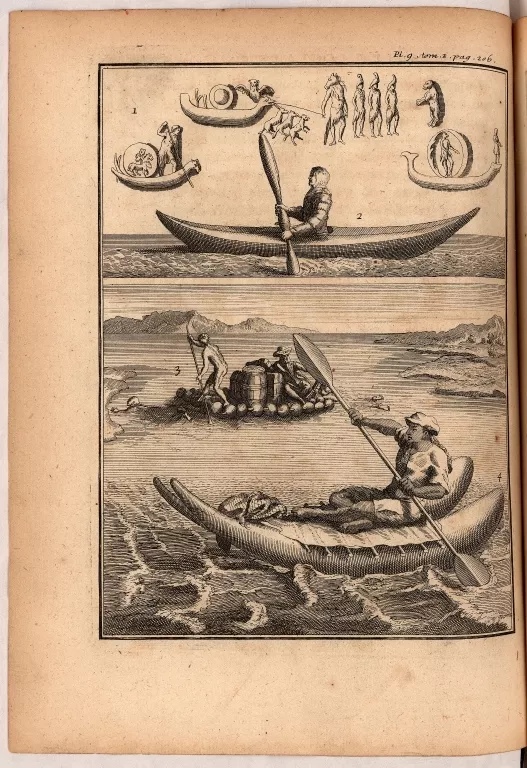
Lafitau dedicates a considerable number of pages to describing the various boatbuilding techniques of Indigenous cultures across the Americas. He believed that these practices were similar to ancient European boatbuilding techniques, some of which were still in use at the time that he published Mœurs des sauvages Amériquains. In the image below, he compares North and South American boats to ancient Egyptian riverboats along the Nile. While he does present the Inuit boat distinctly from the Peruvian boat, the comparison of both of them to ancient Egypt flattens the variety of techniques, environments, and knowledges that these different groups had regarding boatbuilding.
War Prowess and Brutality
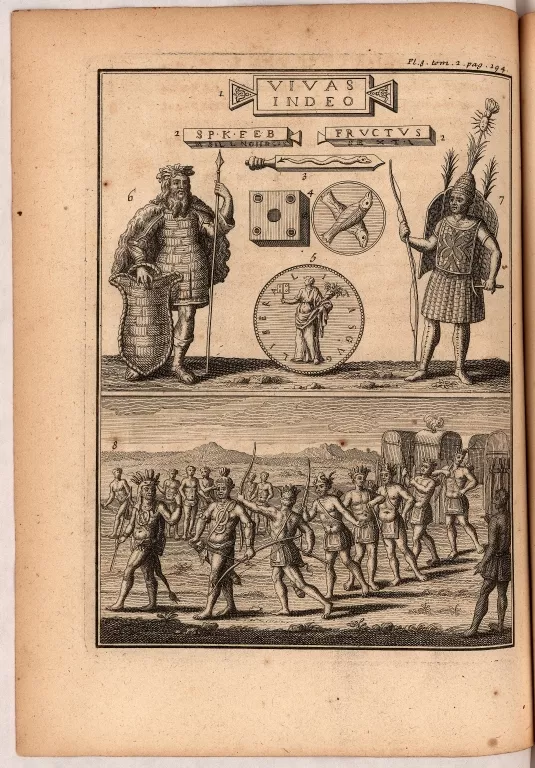
Just as was his style when describing crafts, Lafitau’s chapter on warfare focuses on comparisons between war practices of Indigenous Americans versus those of ancient/Classical societies. While war was significant in the social structures of both societies, Lafitau took special care to express importance that it had to the Iroquois – this chapter is one of the longest in the book. According to Lafitau, the Iroquois saw warfare as an art form: able to be mastered, valuable to society, and inherently beautiful when performed well. However, in his discussion about what was perceived as good warfare, he makes many comparisons to warriors of classical ancient societies and projects these standards onto Native populations.
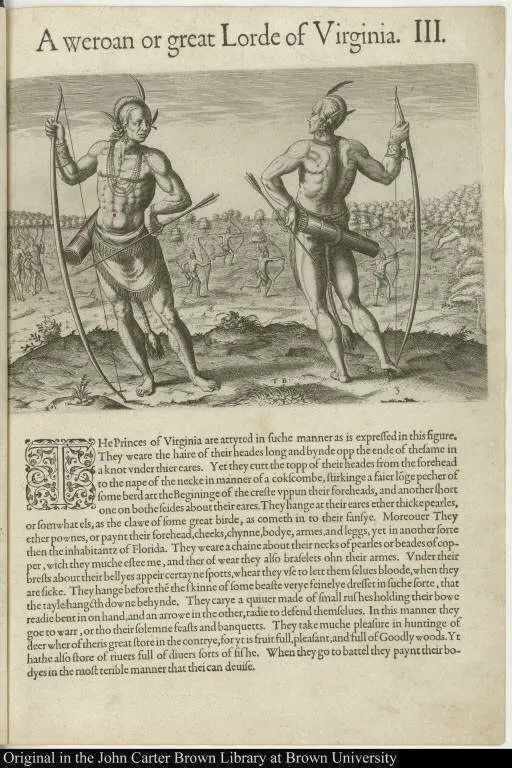
Lafitau generously praises the Iroquois people’s prowess in war, richly narrating their use of skillful archery and military fury to defeat neighboring enemies. The depictions of Indigenous forces that we are shown, too, very clearly demonstrate a certain gallantry and expertise which were typically not awarded to Indigenous people in early modern European illustrations. The image below, from Thomas Harriot’s Briefe and True Report (1590), presents a more typical depiction of Indigenous Americans, showing them as highly disorganized, barely clothed, and ill-positioned to actually fight to defend themselves. Harriot’s writing belittles Indigenous war capabilities, mocking their primitive wooden weapons and traditions involving war paint. By contrast, in Lafitau’s illustration of Native war practices, he chose an image of a warrior not just clothed in armor, but also armed with a combination of natural and man-made weapons that Europeans themselves used. In fact, the way in which Lafitau disregarded conventions surrounding the typical depiction of Native people makes it far tougher to tell when it is in fact Indigenous people being illustrated versus the ancient European societies that Lafitau compares them to throughout the book. This would have been true for people reading the book directly after it was published as well as today — which, in itself, may have been a result of an intentional stylistic choice by Lafitau (and his illustrator) to further his point that Indigenous peoples are strikingly similar to Europeans’ ancient ancestors in their war capabilities.
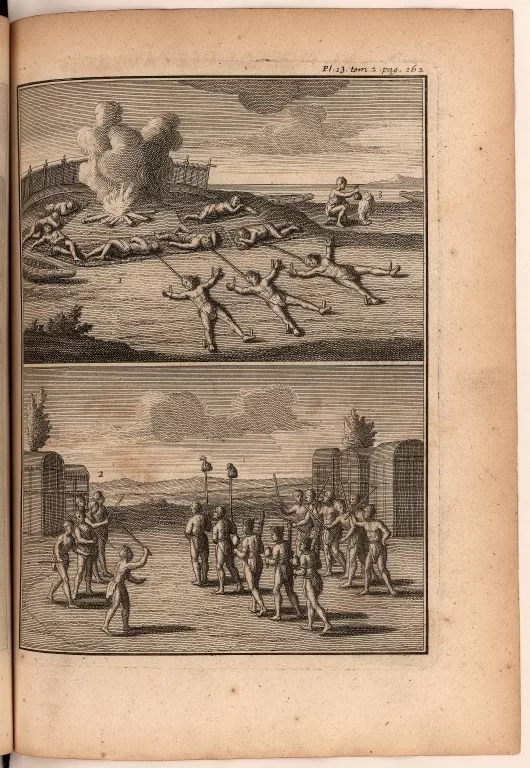
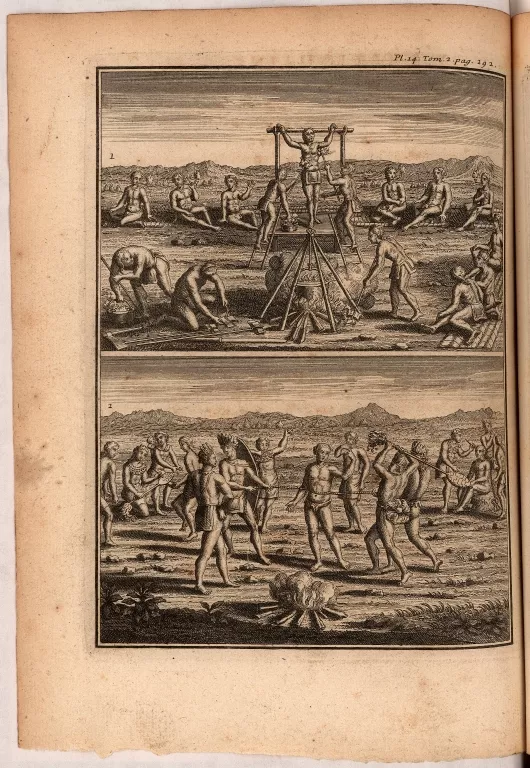
Lafitau goes on to describe the Indigenous people’s treatment of defeated or captured enemies, once again noting similarities to classical ancient societies. In describing common Indigenous practices with prisoners of war — burning of live bodies, removing hair, killing via repetitive blows to the head — Lafitau’s tone changes from one of admiration and respect to one of criticism. He takes issue with the brutality of their practices, encouraging readers to do the same until he artfully reminds them that their own ancestors, the Scythians, exhibited the same wild and unruly behavior in war. On post-battle drinking habits, Lafitau writes, “Mais les Sauvages Meridionaux boivent si bien, á la façon des anciens Scythes, & sont d'une yvrognerie si demesurée, qui'il n'y a pas actuellement de Nation au monde qui puisse leur être comparée en ce point.” (Volume 2 pp. 297-298). Essentially, he details Indigenous fighters’ heavy drinking after taking prisoners in a battle and asserts that they measure up to ancient Scythians in this respect. This almost immediately softens any previous criticism or denunciation in Lafitau’s tone. The illustrations in this section of the text follow suit, straying far from depicting Indigenous people as monstrous or animalistic. Even as Lafitau details the inhumaneness he perceives in Indigenous practices with war prisoners, the illustrations of these practices show them as systematic processes in the context of an organized and adept society. No act of violence depicted appears random or impulsive; they either appear ceremonial — at the center of the scene with a deliberate crowd of observers — or highly standardized — with the placement/organization of enemies clearly premeditated for some defined purpose. Thus, although these depictions may be considered graphic, they also rebutted the idea that the brutalistic practices of Indigenous people were just a side effect of their alleged inherent savagery. Lafitau instead seems to be arguing that these practices were a conscious choice Indigenous people were making, which could be changed (presumably by Europeans) with the right motivation.
Notably, this narrative about Indigenous warfare was very clearly scaffolded specifically to complement Lafitau’s main argument. It first solidifies Indigenous war capabilities at the same level as ancient Europeans, in terms of everything from skill or organization to impressiveness. Given the European emphasis on the value of wartime prowess, this comparison argues for the fact that Indigenous societies were fundamentally as advanced as classical ancient European civilizations. This point goes along with Lafitau’s subsequent argument to ultimately contend that although certain Indigenous practices are brutal, this brutality is not inherent to them as a people. Instead, they can be guided — and are worth guiding, due to their similarity to ancient European ancestors — towards more humane practices, an undertaking which conveniently justifies more missionary expeditions to the new world like the very one Lafitau was on.
Conclusion
While Lafitau argues less for the subjugation of native people than many other contemporary writers, his words and illustrations still present Indigenous people as in need of European rule. From religion to crafts to warfare, Lafitau argues that Indigenous people do have their own developed forms of knowledge — which is evidence that they have potential to evolve — but by highlighting a need for them to alter their ways of knowing to fit European conventions, he projects a Eurocentric and imperialist agenda onto the Americas.
Editorial Note
Edited and Adapted for Americana by Michal Loren.
This essay and the related annotations belong to the student-led project Illustrating Knowledge of the Americas in European Print, 1590–1781. Learn more at the project homepage: https://americana.jcblibrary.org/Illustrating_Knowledge/
Project Creator(s)
- Michal Loren
- Rachel Moss
- Emily Monty
- The John Carter Brown Library