
The Italians and the Creation of America (Published Catalogue)
The contributions of Italians to the creation of America began well before the voyages of Columbus. Italian merchants had traveled throughout the known world for centuries. Some of them ventured into areas unknown to all but a very few Europeans, and their reports, reflecting the mercantile virtues of keen observation, bold curiosity, and self-possession in the face of adversity and in the midst of alien surroundings, expanded the geographical knowledge of all Europe and raised questions about what lay beyond the horizon. Then, in 1406, the cultural fruit of Italian mercantile activity—the movement we call the Renaissance—introduced a new element to geographical thought: the classical, theoretical geography of the second-century author Claudius Ptolemy. The recovery of Ptolemaic texts made possible by a Florentine merchant, Palla Strozzi, provided a structure for the detailed information being sent back from distant lands. Ptolemy’s Geography excited curiosity for further information and enabled readers to relate that information to an expandable framework while at the same time questioning the limits of that framework. Thus, while the Venetian Ca da Mosto, who sailed for Prince Henry in the 1450’s, shared many characteristics of Marco Polo, Ca da Mosto wrote, and was read, in a very different context. Marco Polo’s China had seemed a strange, fantastic land unconnected with the world of Polo’s audience. The sub-Saharan Africa described by Ca da Mosto was an extension of the world: a piece to fit into an incomplete puzzle. Observation interpreted by theory and theory tested by observation make the interplay required by scientific discovery. And within two distinct but related Italian traditions that interplay existed and resulted in nearly a century of creative geographical thinking that preceded, and resulted in, Columbus’s discovery.
The great Italian explorers—Columbus, the Cabots, Vespucci, Verrazzano—all came from Italian merchant colonies abroad. They were Italiani fuori d’Italia, Italians outside of Italy. They shared the culture and the values of those colonies and shared a centuries- old tradition of Italians serving as the intellectuals of Europe—as financiers, architects, advisors, teachers, engineers, and explorers to every court of the continent. While loyal to the service of their masters—the Kings of Spain, England, Portugal, and France— Italians abroad never lost their Italianita, reinforced perhaps by their being fuori d'Italia.
Perhaps the most important contributions of the Italian explorers were intellectual. Surely, they risked their lives. But even more than the physical risks taken, they conceived bold, well-founded plans, made accurate and intelligent assessments, and reported in clear and vivid language. It was these characteristics which made the contributions of Italian explorers out of proportion to the number of individuals involved—characteristics which Italians had practiced in their own affairs and in service to foreign rulers for several centuries.
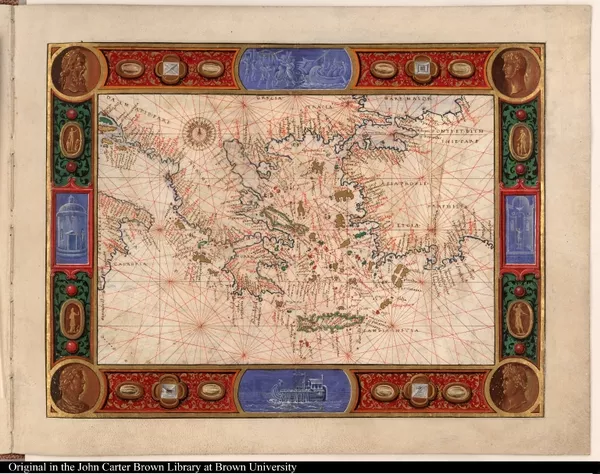
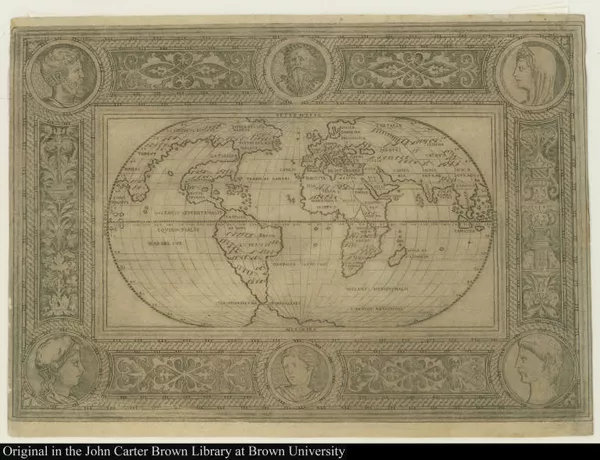
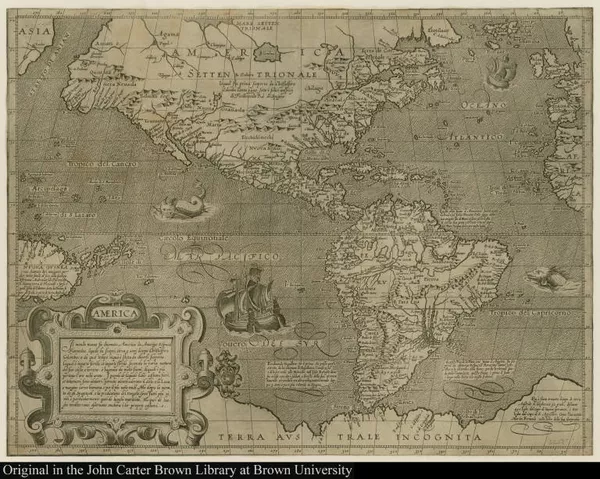
The most graphic expression of this Italian tradition was in their mapmaking. Itahan experience at sea had been combined with the ability to resolve the mathematics of navigation to create an Itahan school of mapmaking which was centuries old by the time of Columbus. The practical need of the merchant traveler to find his way at sea was expressed in beautiful portolan charts which were precise and, for those trained to use them, scientific. The Age of Discovery taxed Itahan cartographers. Information about new lands arrived from second-hand sources and was often imprecise, perhaps garbled, and frequently conflicted with other information. The cartographer had to incorporate the information while resolving the more complex mathematical formulas required to portray a world expanding with each decade. The boldness of Itahan cartographers in confronting these problems, the skill, imagination, and patience required for such confrontation, is not as well recognized as the comparable achievements of the explorers. Yet the cartographers of Genoa, Venice, and Rome helped to create the way America was perceived and understood.
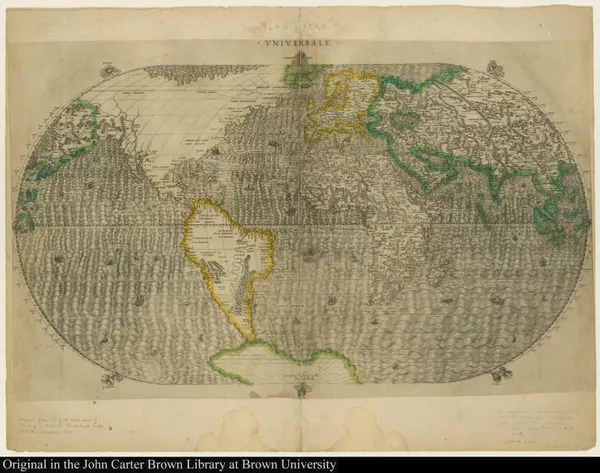
The world map of 1569 by Giacomo Gastaldi represents a turning point in the role of Itahan cartography and America, and in the role of Italian culture and America as well. In 1570 Abraham Ortelius in Antwerp started publishing a series of maps which signaled the shift of cartographic dominance to the cities of northwestern Europe. Diplomatic, economic, political, and to some degree cultural dominance was shifting concurrently from the Mediterranean to the Atlantic.
For the next two centuries, individual Italians participated in aspects of America, but America existed only on the fringes of Italian culture. The presence of Spain, both in America and Italy, prevented direct participation in America by any of the Italian city-states (there were early hopes in Tuscany to do so) and Italy did not greatly benefit from the expansion of wealth which the colonial powers shared.
The experience of the American Revolution returned America to a more important place in Italian culture. Benjamin Franklin played a symbolic role in representing America as a place where the ideals of the Enlightenment were realized. The example of the thirteen colonies, each retaining sovereign rights, uniting to solve common problems and freeing themselves from a foreign power, was admired by many Italians. Carlo Botta studied the American Revolution for its application to Italy; Vittorio Alfieri wrote odes praising its leaders; Carli, Maffei, Castiglioni studied the society which supported it.
One consequence of the absence of Italy as a colonial power in America is that the contributions of Italians in creating America have not received much attention. While this Exhibition can only touch upon certain aspects of those contributions, we hope to foster greater interest and further study of the subject.
The Exhibition is drawn entirely from the collections of the John Carter Brown Library. Many books were in the original collection formed by John Carter Brown between 1846 and 1874. Although the founder of the Library left statements concerning his concept of its goals, the breadth and richness of his collecting reveal his deep vision and the variety of his conception of the subject of America. Some of the finest individual items in this Exhibition, including the Agnese and Maggiolo atlases, the 1477 Ptolemy, and the illustrated Basel, 1493, edition of the Columbus letter, were added by John Carter Brown’s son, John Nicholas Brown. When John Nicholas Brown died in 1900, his will left the “Bibliotheca Americana,” money to construct a library building, and an endowment for its maintenance, to Brown University as a memorial to his father. Succeeding librarians, George Parker Winship, Worthington Chauncey Ford, Lawrence Counselman Wroth, and Thomas Randolph Adams, have enlarged and enriched the collection. Books added by each of them are found in the Exhibition. The collection of maps given to the Library by George EL Beans between 1957 and 1962 is especially commemorated in the text. When the Exhibition opened in December of 1976 we were able to say that “seven of the nine books in Case Four were obtained within the last two years, including the Venice, 1543, edition of Albergati’s La Pazzia which arrived in the Library just three weeks before the opening of the Exhibition.” Since that time other books have been obtained, and we have been able to include some of them in this catalogue.
The Exhibition rests upon a great foundation laid over a century ago, but much of its character and diversity reflect the active expansion and continued interpretation of succeeding librarians. We hope that the future will be as fruitful.
When the Exhibition appeared in 1976 I was able to thank a number of those who shared the work. Diana Steimle, Eva Stigers, Susan Danforth, and Richard Hurley contributed to making that first effort possible. John Alden brought felicitous hand and felicitous phrase to it. Thomas R. Adams, Librarian of the John Carter Brown Library, offered encouragement, freedom, and critical suggestions of the text which are greatly appreciated. I thank them all once again.
At that time I encouraged readers to “offer corrections, improvements, or appropriate observations so that in its next stage, the Catalogue will be more worthy of its subject.” A number of readers responded: Giuseppe Billanovich, Jeannette Black, Elizabeth Cometti, Franco Fido, Anthony Molho, Anthony Oldcorn, Antonio Pace, Bernard Rosenthal, Robert Rosenthal and the students of his seminar at the University of Chicago, and John Tedeschi all made contributions. Classes of schoolchildren who visited the Exhibition asked questions which helped me to recognize places which needed expansion or clarifying. The Lilio (number 18) was added to the Exhibition for them. My wife, Penelope, helped prepare the index, she read and helped clarify an early draft of this text, and she has tolerated many evenings given in its fruition. Mrs. Raymond Watts, the Library’s invaluable “Doppie,” took the manuscript home and applied red pencil to the text’s benefit and the reader’s gain. Susan James Demers and Lynne Southwick bore the typing of this cheerfully. I thank them all and only regret that I cannot ask them to share the blame for the mistakes which you, reader, must inevitably find. I ask that you be forgiving and again ask you to offer your corrections, improvements, or appropriate observations.
When Vincent Buonanno and I planned this, we decided to seek financial support from our community to pay the necessarily high printing costs. The work involved in that effort has been considerable and the time consumed extensive. It has been gratifying to have received the support we have. At a time when it has become almost automatic to turn to agencies of the federal government for support of such publications, it is reassuring to know that there are individuals in the community who are concerned enough about our heritage to contribute to a publication of this kind. A grant from the government might have been a faster way of accomplishing our goals, but I would have missed meeting the fine people who participated in this and would have missed making many friends. I thank the Committee members who spent their valuable time and staked their reputations on our behalf. And, finally, I thank the patrons who made this possible. I hope that they find their confidence in the project was warranted.
1. The Discovery of Discovery
The prominent part played by Marco Polo, Christopher Columbus, and the other Italians involved with new geographical discoveries is not an historical coincidence. The great explorers flourished in a society and a culture which produced attitudes and skills which these talented men required.
In the twelfth and thirteenth centuries the Italian city-republics had developed economies that generated surplus capital. Such inventions as double-entry bookkeeping and letters of credit enabled Italian bankers to manage money and direct it to constructive and profitable use.
Europeans eagerly sought Italian capital, and Italian merchants and bankers were attracted to all the commercial centers of the West. But investments made beyond their own jurisdictions were dangerous: not only were there normal commercial risks, but they lacked political protection beyond their own city. Intelligence and training were required for survival: Italian businessmen were trained to calculate instantly, judge shrewdly, observe broadly, and reason acutely. These skills—-the genius of Italy— permeated all levels of cultures: they were as much a part of the manner in which Italians looked at paintings as they were of Italian methods of looking at new lands and new maps.

2. Columbus
The geographical questions that Columbus asked represent the culmination of an intellectual process that had begun and flourished in Italy. Columbus had read the books of Marco Polo and Pius II (from whom he learned his Ptolemy) as well as those of other geographers. He had obtained a copy of a letter written in 1474 by Paolo del Pozzo Toscanelli, the leading Florentine geographer, who thought a western ocean passage to China was feasible. He knew merchants and pilots who had sailed the African coast. From his reading and discussion Columbus became convinced that Asia could be reached by sailing to the West. Ships and navigation had advanced to such a point that long oceanic voyages became possible. In the summer of 1492 Spain’s political situation enabled the release of funds to pay for the ships Columbus needed. He had the opportunity of proving his theory. When he encountered land where he had projected Japan to be, Columbus believed that he had demonstrated his idea to be correct.
Christopher Columbus, and others
Epistola Christofori Colom: cui [a]etas nostra multu[m] debet: de insuli...
1493
Christopher Columbus, and others
De insulis inuentis : Epistola Cristoferi Colom (cui [a]etas nostra mult...
1493
Christopher Columbus, and others
Eyn schön hübsch Lesen von etlichen Insslen die do in kurtzen Zyten fund...
1497
Christopher Columbus e.a.
Libretto de tutta la nauigatione de re de Spagna de le isole et terreni ...
1504
3. Vespucci
Amerigo Vespucci may not have been the first to realize that a new continent had been discovered, but his letters were the first revelations of that startling fact that were read by a large audience throughout Europe. The letters attracted readers not only because of the news of a New World, but because of their vivid descriptions of the cannibalism and sexual promiscuity of the natives. Vespucci placed himself at the center of action and attention and this brought him rapid and lasting fame, but it also makes him, in Samuel Eliot Morison’s words, “the most controversial character in the history of discovery.”
Vespucci was born in Florence in 1451 of a leading family and worked for the Medici bank from his youth. In 1491 the bank sent him to work in its Seville affiliate where he was a merchant banker and ship chandler. As chandler, at the port from which Columbus and all the following Spanish voyagers to America set sail and to which they returned, Vespucci had detailed information about the earliest voyages of discovery. Vespucci made three voyages to America. In 1499 he accompanied a Spaniard, Alonso de Hojeda, who sailed along the Spanish Main. Then, forbidden to sail in a Spanish ship, he went out as a member of two Portuguese fleets both commanded by Gonçalo Coelho in 1501-1502 and again in 1503. What makes Vespucci so controversial is that he claimed to have made an earlier voyage, in 1497—a voyage which only his keenest partisans have believed ever took place. Furthermore, he wrote as if he had led the three voyages he did go on—he gave credit to no one but himself, and this discredited him among his contemporaries beginning with Sebastian Cabot in 1515.
Lorenzo di Pierfrancesco de' Medici e.a.
Alberic[us] Vespucci[us] Laure[n]tio Petri Francisci de Medicis salutem ...
1503
Amerigo Vespucci, and others
Von der neü gefunden Region so wol ein Welt genempt mag werden, durch d...
1505, cop.2
Amerigo Vespucci e.a.
Van der nieuwer werelt oft landtscap nieuwelicx gheou[n]de[n] va[n]de[n]...
1507
Martin Waldseemüler, and others
Cosmographiae introductio : cum quibusdam geometriae ac astronomiae prin...
1507
4. The Impact of the Discoveries upon Italy
The discovery of a new world broke down centuries-old concepts which Europeans held concerning the earth they lived on. As ideas about the relationship of the parts of the earth changed, so did ideas of the place of an individual on the earth and in the cosmos. This required adjustments not merely in geographical thinking but in metaphysical, political, and religious attitudes as well. This section includes books which reveal the way in which Italian thinkers confronted the breakdown of old ideas and worked to replace them with new.
Giovanni Cotta e.a.
In hoc operae [sic] haec contine[n]tur Geographia Cl. Ptholemaei a pluri...
1507
Giovanni Francesco Pico della Mirandola, and others
Ioannis Francisci Pici Mirandulae domini et concordiae comitis, De rerum...
1507
Ascanio Persio e.a.
La pazzia
Charles Walker Andrews e.a.
Descrizione della entrata della serenissima regina Giouanna d'Austria
1566
5. Italian Historians of the Great Explorations
Information about the New World reached Italy in many ways: through travelers’ stories, personal letters, reports by merchants, dispatches of Italian ambassadors to European courts (and of their spies), reports of missionaries to their superiors. The first writers to assimilate the information on America and to present it to the public were Italians.
The letters of Columbus and Vespucci are the best-known Italian personal narratives of the discovery period but by no means the only ones. Besides the three described below, this catalogue also contains the account of Verrazzano found in Ramusio’s 1556 collection of voyages.
Nicolao de Albenino, and others
Verdadera relacion: de lo sussedido en los reynos e prouincias d[e]l Per...
1549
Pietro Martire d' Anghiera, and others
P. Martyris Angli Mediolanensis Opera : Legatio Babylonica ; Occeani dec...
1511
Giovanni Battista Ramusio
Terzo volume delle nauigationi et viaggi nel quale si contengono le naui...
1556
Antonio Possevino
Apparato all'historia di tutte le nationi. Et il modo di studiare la geografia
1598
Italy as Channel of Information [after 5]
News tended to gravitate to Italy during the fifteenth century, and Italy was a conduit through which much of the news of America passed to the rest of Europe. Northern Europeans often learned of Spanish activities through Italian translations such as the early account of the conquest of Peru which follows.

Francisco de Xerez
Libro primo de la conquista del Peru & prouincia del Cuzco de le Indie O...
1535, cop.1
VI. The Reputation of Columbus in Italy
Columbus's reputation, at first eclipsed by the fame of Vespucci, steadily improved once it was realized that the Indies of Columbus were Vespucci’s Mundus Novus. Fifty years after his death Columbus was recognized as a hero. The following works represent some of the stages of his elevation.
Contributor: Agostino Giustiniani
Psalterium, Hebr[a]eum, Gr[a]ecu[m], Arabicu[m], & Chald[a]eu[m] : cu[m]...
1516, cop. 2

Columbus as a Theme in Cinquecento Italian Poetry [after 6]
It took several generations to gain the perspective to appreciate the significance of Columbus and his discoveries and still longer for them to be celebrated in verse. Leicester Bradner, now Professor of English Emeritus at Brown University, has studied sixteenth-century Latin poems using Columbus as a theme.
Lorenzo Gambara, approximately 1495-1585
Laurentii Gambarae Brixiani De nauigatione Christophori Columbi libri quattuor.
1581

Giulio Cesare Stella, and others
Iulii Caesaris Stellae nobilis Romani Columbeidos libri priores duo. : A...
1590
VII. Vespucci as a Theme in Cinquecento Italian Poetry
Vespucci's reputation in the sixteenth century declined as Columbus’s rose. There was no biography of him written then—none in fact until Angelo Maria Bandini published Vita e lettere at Florence in 1745. In such works as Leandro Alberti's Descrittione Di Tutta Italia (the Library has the first edition, Bologna, 1550) the man who is known above all for his first name is mentioned as the prominent Florentine Alberigo Vespucci. Florentines were most concerned with the memory of Vespucci. The following group of poems are all by Florentines; Bandini and Stanislao Canovai, who took up Amerigo’s cause in the eighteenth century, were Florentine as well.
VIII. Italian Physicians and America
The discovery of America had significant medical ramifications. New diseases were encountered here, although Europeans, hardened by over a century of bouts with the plague, carried with them many more to America. Oceanic travel presented health hazards and spread diseases across the seas. New medicinal plants were found in America and helped solve some medical problems.
Italian physicians were involved in solving some of the problems and disseminated some of the medicines. This is to be expected as Italian medical schools, traditionally the best in Europe, made enormous contributions to advances in the whole range of medical science during the period 1500-1800. The following section is a sampling with two books on an American disease, syphilis, and two on an American medicine, quinine.
IX. Italian Missionaries on the Frontiers of Seventeenth-Century America
The seventeenth century was a period of consolidation, growth, and expansion for the missionary orders. By this time they had reached to all parts of Spanish, Portuguese, and French America. Italians were involved as missionaries in all orders and in all regions, and their work and writings are an important legacy.
Information about frontier areas from non-Italian missionaries often appeared first in Rome because, as the place where the orders’ headquarters were located, reports of activities were sent there regularly.

Francesco Giuseppe Bressani
Breue relatione d'alcune missioni de' PP. della Compagnia di Giesù nell...
1653
Alonso de Ovalle, and others
Historica relacion del reyno de Chile : y de las missiones, y ministerio...
1646, cop.1
X. The Seventeenth Century
During the seventeenth century there were no startling discoveries of unexpected new lands, new peoples, or new wealth to catch the attention of Italians as in the previous century. Italy itself was caught up in problems of its own. Furthermore, access to America was controlled by the enormous power of Spain. As a result there are fewer books, certainly fewer which contain direct, accurate, and important news from America, printed in Italy during this century than in the sixteenth century. Nevertheless when opportunity presented itself, there were enterprising individuals who seized it.

Samuel J Hough e.a.
La science de l'homme de qualité ou L'idee generale de la cosmographie,...
1684
XI. Italian Erudition and the Preservation of American Artifacts
The role of early Italian scholars and collectors in preserving the manuscripts and artifacts of American Indian cultures is not appreciated, yet without these acts of preservation the study by later generations would have been impossible.
Throughout the period 1500-1800 Italian collectors continued the great tradition established in previous centuries of forming private collections of objects. The Medici, Grand Dukes of Tuscany, formed extensive collections of paintings, precious stones, scientific instruments, stuffed animals, and manuscripts, which are the basis of several national museums. A recent study by Detlef Heikamp, Mexico avid the Medici, Florence, 1972, reveals the extent of the Medici collections in one area. Heikamp also contributed an article on our theme, American Objects in Italian Collections of the Renaissance and Baroque: A Survey, to the book First Images in America.

XII. Italian Influence on the Arts in Colonial America
The place of Italy in the history of opera, music, and architecture requires no comment, but what is not as well known is how and when the tradition of Italian art began to be imported into the New World. Three items, all known only in the copies in this exhibition (as far as we can determine), represent Italian contributions in three arts. One book was printed at Lima, one at Mexico City, one at Boston: they stand at the beginning at the vast impact Italian art has had in all of America.
Silvio Stampiglia, and others
La Partenope fiesta : que se hizo en el Real Palacio de Mexico el dia de...
1714-1732
Francesco Geminiani
An abstract of Geminiani's Art of playing on the violin, and of another ...
1769
Miguel Suárez de Figueroa e.a.
Templo de N. grande patriarca San Francisco de la Provincia de los Doze ...
1675
XIII. Jesuits from America Exiled to Italy
In 1608 the Jesuits were granted permission to organize the Guarani Indians of Paraguay. By the mid-eighteenth century, under their direction, a self-contained agricultural society flourished. In the 1740’s, settlers from Spanish Argentina and Portuguese Brazil sought to acquire the productive Jesuit/Indian lands. Raids were staged. The Jesuits armed the natives and trained them to defend themselves. Battles ensued. Spain and Portugal came to terms, ignoring the Jesuits and Indians, splitting the lands between themselves in the Treaty of Madrid, 13 January 1750.
The Jesuits, outraged at the injustice, resisted implementation of the Treaty. Spain sent troops who removed the missionaries from Paraguay and, in the decade that followed, Spain and Portugal (and later France) expelled all Jesuits from their domains.
The Jesuits came from various countries, many were Italian, but there were few countries to which they could go freely in their exile. Many of them took refuge in the Papal States of Italy where in exile they wrote works which have become basic studies of much of South America.

Filippo Salvadore Gilii
Saggio di storia americana o Sia storia naturale, civile, e sacra de reg...
1780-1784
XIV. Italian Awareness of English America, 1770-1755
The growth of the English colonies in North America seems to have gone unnoticed throughout most of Europe. In 1755, just before the outbreak of the Seven Years’ War, it has been said that in France all but a few individuals were “almost completely ignorant of conditions there.” The same was true in Italy: we know of few Italian books printed before 1750 that even mention the settlements which were to become the United States. The outbreak of a war for empire between England and France over which nation would control North America—the Seven Years’ War, 1756-1763—made Europeans aware of how powerful a resource the English colonies had become.
Marco Antonio Badia
Compendio della guerra nata per confini in america tra la Francia e l'In...
1763

Gottfried Achenwall, and others
Précis de l'état actuel des colonies angloises dans l'Amérique septentrionale
1771
XV. Benjamin Franklin and the Italians
For many Italians in the second half of the eighteenth century, Benjamin Franklin represented Anglo-America. They became aware of him in 1752, as a result of his electrical experiments, at the same time as they were becoming aware of the potential of English North America. For the next forty years Franklin’s writings and character made deep impressions on Italians.
Benjamin Franklin, and others
Opere politiche di Beniamino Franklin L.L.D. F.R.S. : nuovamente raccolt...
1783
Benjamin Franklin e.a.
Descrizione della stufa di Pensilvania inventata dal signor Franklin americano
1788
XVI. Italian Contributions to American Political Thought
The founders of the American republic owed much to Italians. At one level there were the writers on political and social problems. Then there were the examples of the Italian republics which survived into the eighteenth century—Venice, Genoa, San Marino, and Lucca. Finally, in the 1760’s there was the stirring struggle of Pasquale Paoli’s Corsicans to free their island from foreign domination. Paoli, Pennsylvania, not far from Valley Forge, was named by its settlers for a patriot they were soon to emulate.
XVII. Italians and the American Revolution
The American war was at first perceived by Frenchmen, Italians, and other Europeans as the overthrow of British political and economic domination. To this theme Italians were particularly sympathetic, and the example of the thirteen American colonies—each with its own interests, each maintaining a degree of sovereign power but working together to accomplish common goals—had special meaning. As the war continued and Italians learned more about it, perceptions of its significance changed. The struggle was also seen as a revolt of an entire people against the tyranny of absolute power, a mass assertion of the inalienable rights of man. This social aspect of the Revolution was greeted with enthusiasm or regretted, according to the individual’s political vantage.
Jean-Antoine-Nicolas de Caritat Condorcet e.a.
Recherches historiques et politiques sur les États-Unis de l'Amérique ...
1788

Carlo Botta, and others
Storia della guerra dell'independenza degli Stati Uniti d'America.
1809, v.1
XVIII. The Italian Cartographic Tradition
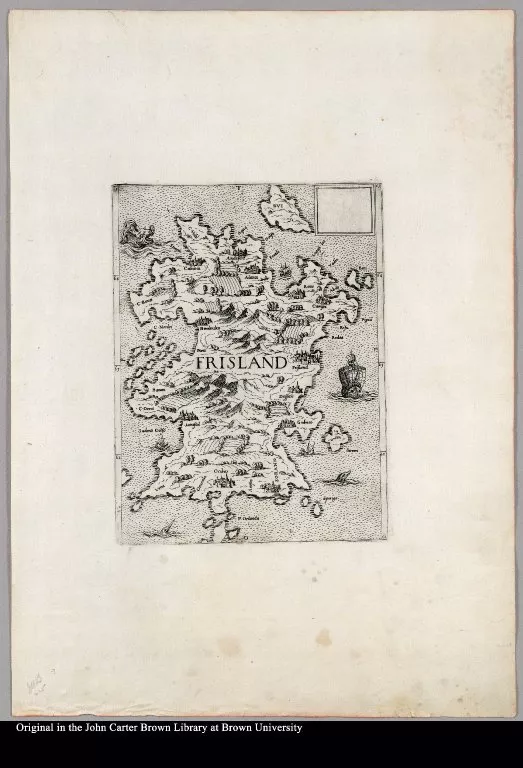
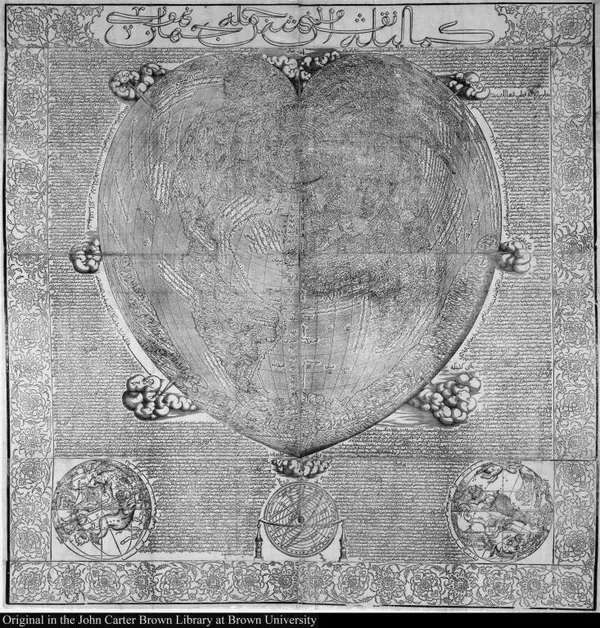
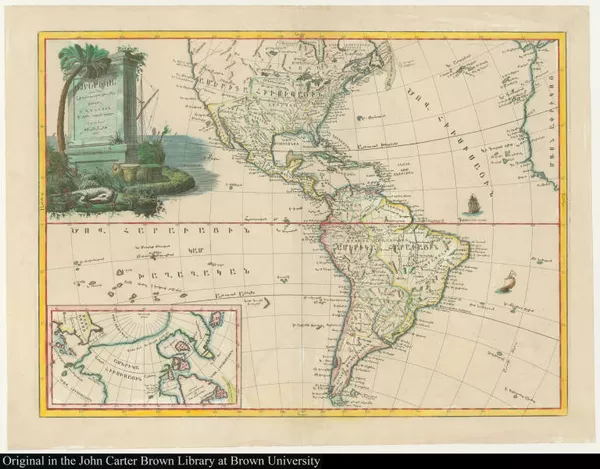
There were three reasons for Italian superiority in cartography: a centuries-old tradition of portolan chartmaking; access to abundant and accurate information; and a skill in the art of engraving which advanced concurrently with the increase of information about America. Portolani were books of sailing directions, with charts of harbors, seacoasts, etc. They were designed solely for mariners and contained coastal details, but information about the interior is neglected or omitted entirely. By the time of the Age of Discovery, portolan maps had been made for several centuries, and their makers had achieved a conventional, geometrical style recognized by all.
The art of engraving was developed by goldsmiths, who first used the technique to record their ornate designs. In about 1450 some goldsmiths began making copperplate prints. During the next century Italian artists elevated copperplate engravings to very high levels. The technique was most appropriate for mapmaking as it allowed great detail to be recorded with clarity and precision.
The contributions which Italian mapmakers made toward the concept of the American continent and the dissemination of knowledge of America are so considerable as to deserve their own separate section.
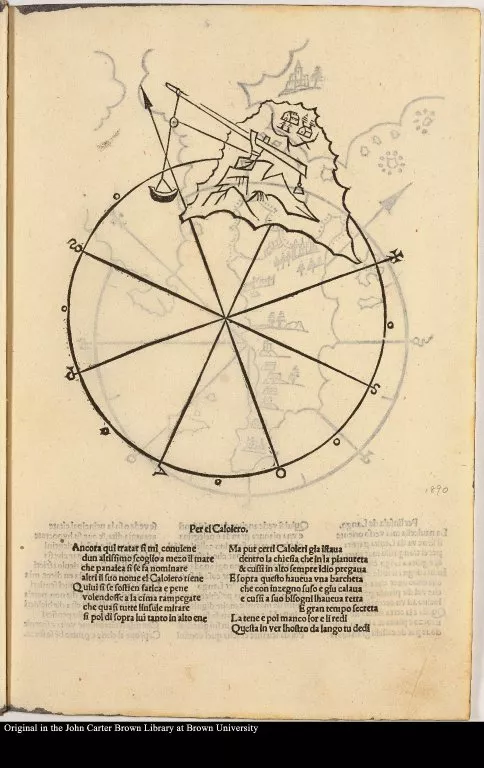
[Island of Caloleri]
1532
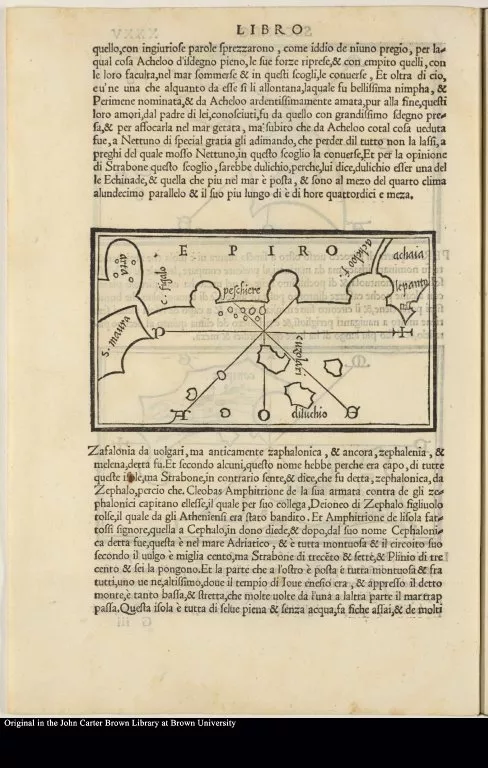
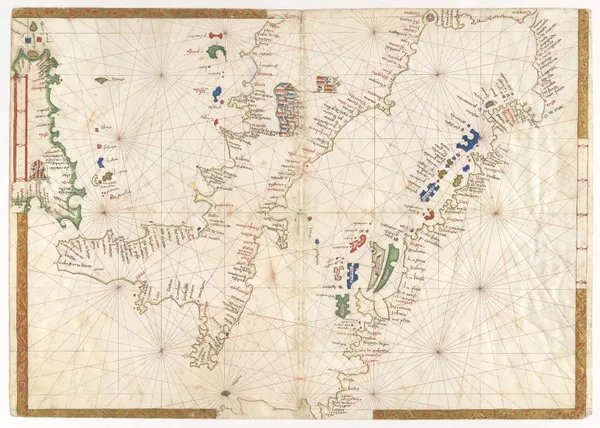

[Map of the world]
1565
[World map]
1552
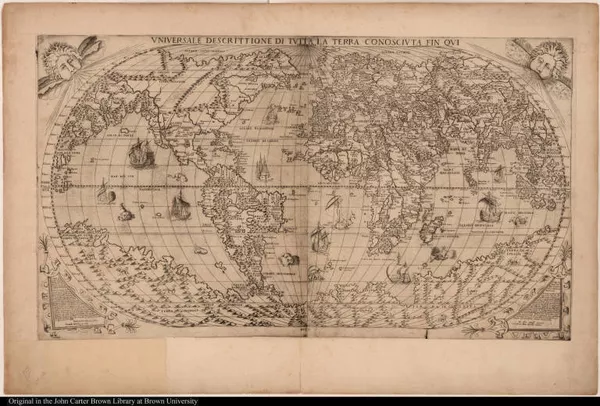
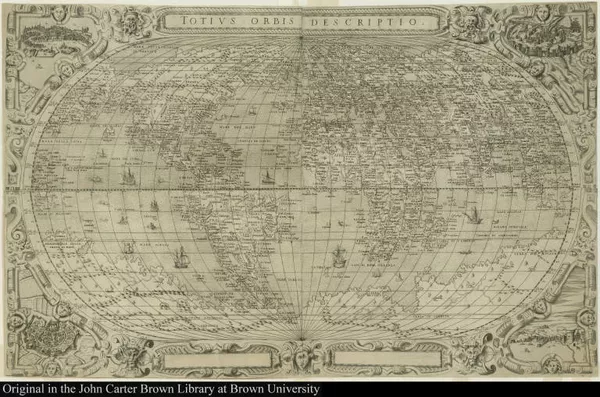
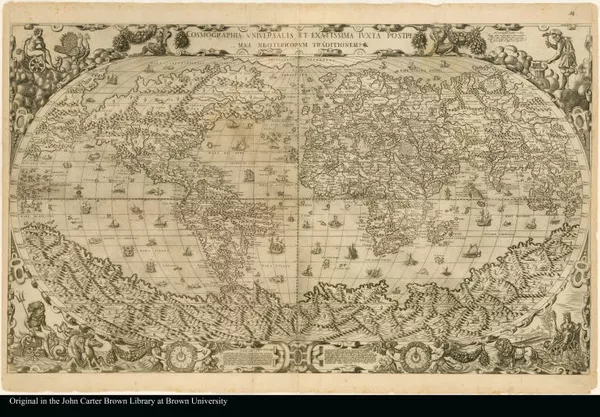
Giovanni Francesco Camocio
Cosmographia Vniversalis Et Exactissima Ivxta Postremem Neotericorvm Tra...
1569

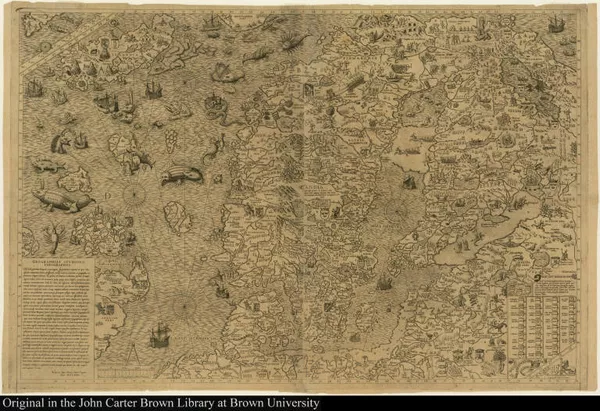
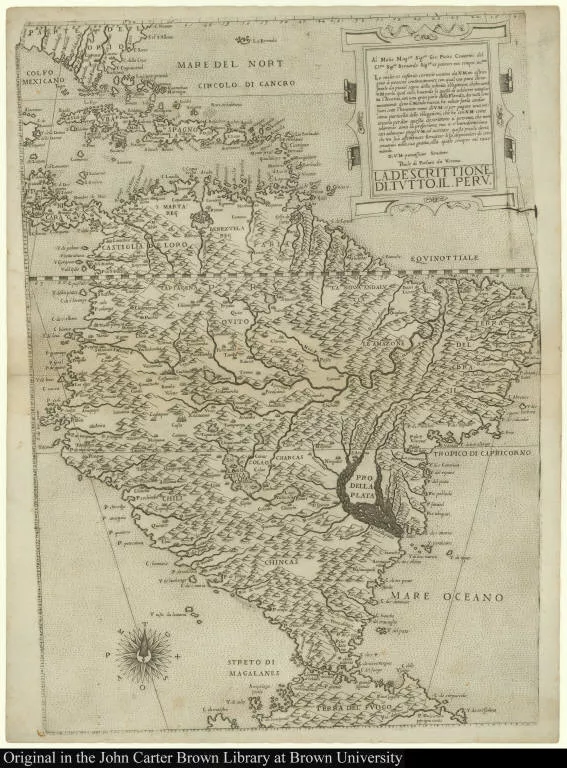
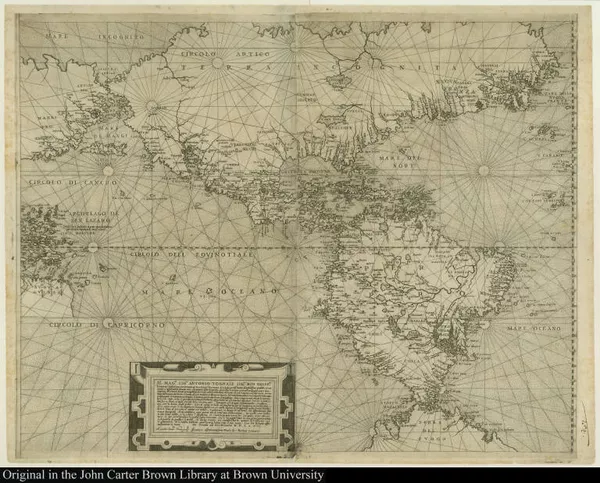
Diego Hermano di Toledo e.a.
... un disegno, ouero una particolar descrittione di tutte le nauigation...
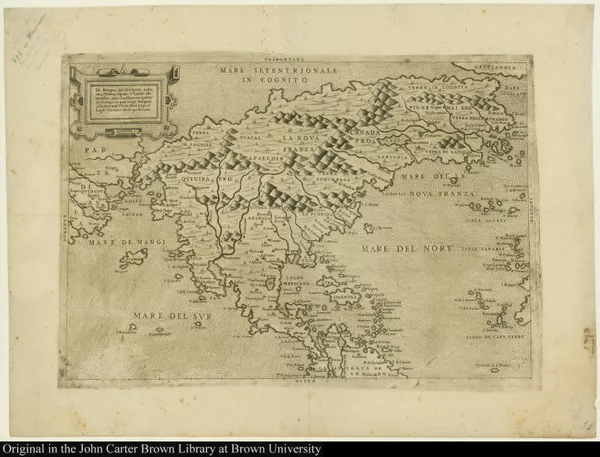

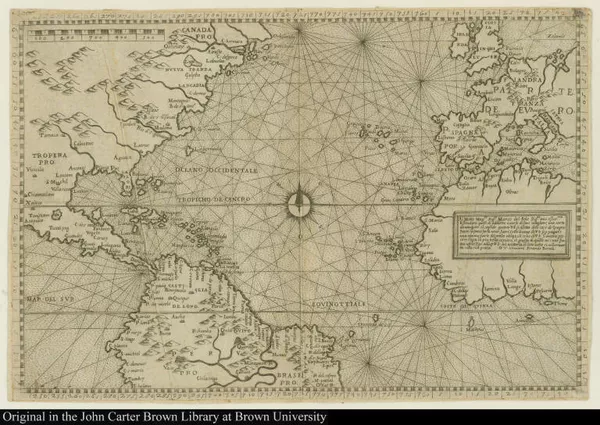
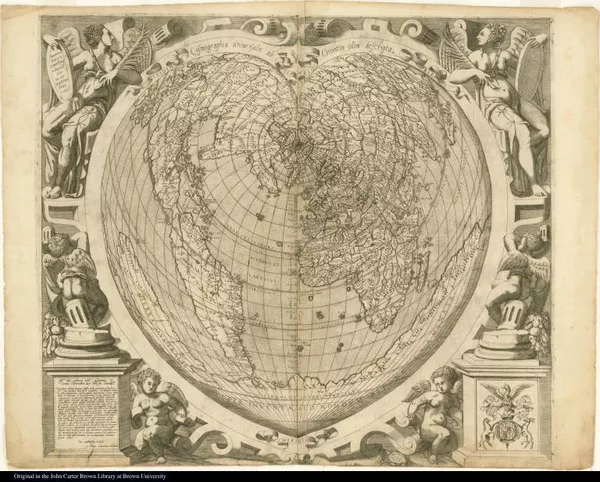


Antonio Francesco Lucini
Carta prima Generale d'America dell' India Occide[n]tale è Mare del Zur.
1661
Jean Baptiste Nolin e.a.
Palestra litteraria, o invito dell' accademia cosmografica a' suoi Argonauti
1705

Vincenzo Scotti
Tavola delle più esatte ed usitate Bandiere che si alberano a Bordo dei ...
1751-1800
Items Pending Integration
During the migration of our legacy catalogs and past exhibitions into Americana, there are occasionally items that cannot be immediately included in our new environment. This may happen for two reasons: the item in question is not yet cataloged, or it was lent by another institution.
Any items that are not integrated into Americana are included in this section and added to our processing queue.
CLAUDIUS PTOLEMAEUS
Cosmographia.
Bologna [1477].
The works of the geographer Ptolemy (lived second century a.d.) became available to Italy in 1406 when a Florentine merchant, Palla Strozzi, paid to have a Greek manuscript translated into Latin. Ptolemy provided the concept of a grid system for geographical measurement as well as the mathematical procedures for measuring the size of the earth and for making maps of large land areas. Ptolemy also determined the latitudes of locations throughout the Mediterranean area. He tried as well to approximate exact locations of sites in more remote regions of the world. Italian scholars adopted Ptolemy’s rigorous mathematical system as a basis for their own studies. Just as Florentine artists combined a mastery of abstract principles of mathematical perspective with a grasp of practical, empirical elements to create a new kind of painting, so too the humanistic scholars combined the technical, mathematical procedures of Ptolemy with the increasingly available records of travelers’ observations to create a new analytical geography. This is the first edition of Ptolemy with maps and it is the first book to be illustrated with copperplate engravings. The world map shows Ptolemy’s second-century concept of a land mass connecting Africa and Asia, making the Indian Ocean an enclosed sea, which was the starting point of fifteenth-century discussions of the remote islands.
jcb (3)1:11; j cb Collection s Progress 47; Sabin 66471; R. A. Skelton, “Bibliographical Note” to facsimile published Amsterdam, 1963, by Theatrum Orbis Terrarum; World Encompassed, 34 (plate x); Samuel Y. Edgerton, “Florentine interest in Ptolemaic cartography as background for renaissance painting, architecture, and the discovery of America Journal of the Society of Architectural Historians, xxxm, Dec. 1974, pp. 275-292.
Acquired 1900 by John Nicholas Brown, the donor.
CRISTOFORO COLOMBO, 1446 /51-1506
[Manuscript extracts of his capitulations with King Ferdinand and Queen Isabella.]
[Spain, November 1504 or after.]
This manuscript is a contemporary summary of the privileges Columbus received from Ferdinand and Isabella between the years 1492 and 1502. As discoverer of the West Indies, Columbus sought and was granted grandiose titles, such as Admiral of the Ocean Sea, which reflected his ambition to obtain feudal control in lands he discovered. As the dimensions of his discoveries became apparent and the crown became aware of the consequent power that he would command, the monarchs—whose life work was consolidating power and reducing feudal privilege—refused to allow Columbus the absolute authority and revenues in the New World he thought were his. This document asserts Columbus’s claims as they existed after the fourth voyage. It was compiled either by him at the end of his life or by his heirs shortly after his death. Generations of his descendants tried, with very limited success, to obtain his privileges. A century and a half later they were given Jamaica as a settlement. In 1655 an English invasion took even that from them.
jcb (3)1:16; S. De Ricci, Census of Medieval and Renaissance Manuscripts in the United States and Canada (1937), vol. n, pp. 2145-46.
Acquired 1890 by John Nicholas Brown, the donor.
GIOVANNI BATTISTA STROZZI, 1551-1634 [First canto of a poem on Amerigo Vespucci, in 93 octaves.]
[Manuscript, Florence, before 1601 .]
This is the first known poem to use Amerigo Vespucci as a subject. It is the first canto—possibly the only one ever completed—by a poet active in Florentine literary circles at the end of the sixteenth century. The poem’s existence was known because of early references to it by Strozzi’s literary friends. A distant relative in the eighteenth century believed that there was a copy in the Magliabecchi Collection, which became part of the National Library in Florence, but the copy is no longer there. This manuscript, probably a contemporary secretarial copy, seems to be the sole copy still extant.
A. S. Barbi, Un Accademico Mercante e Poeta, Firenze, 1900; the poem is published by Professor Franco Fido in the Stanford Italian Review, number 2, September 1979. Acquired 1977. Obtained with a gift from Mrs. Marion Brewington and funds from the Benefactors of the John Carter Brown Library.
[VITTORIO ALFIERI] 1749-1803 La Guerra in America.
[Italy? or Paris? ca. 1784 . Manuscript.]
This manuscript version of Alfieri’s L’ America Libera may have been prepared for sending to America. We know that Alfieri sent manuscript copies of his odes to Washington and to other American leaders, and this may be one of those manuscripts. Alfieri changed his text several times before it was printed for the first time at Kehl; the text in this manuscript is one of the intermediary versions before the printing.
Franco Fido, “A proposito di un manoscritto dell ‘America libera’,” Giornale Storico della Letteratura Italiana, 149 (1972), pp. 469-475; Ernest Hatch Wilkins, “Alfieri in America,” in The Invention of the Sonnet and Other Studies in Italian Literature, Rome, 1959, pp. 295-313. Acquired 1966. The gift of Mrs. Roger Amore Laudati.

Original Catalogues
John Carter Brown Library, and others
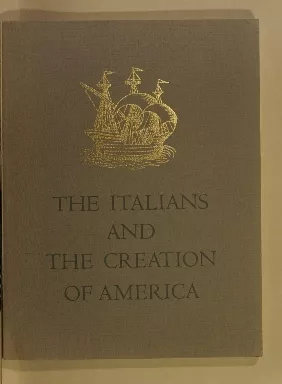
The Italians and the creation of America : an exhibition at the John Car...
1980

Project Creator(s)
- The John Carter Brown Library