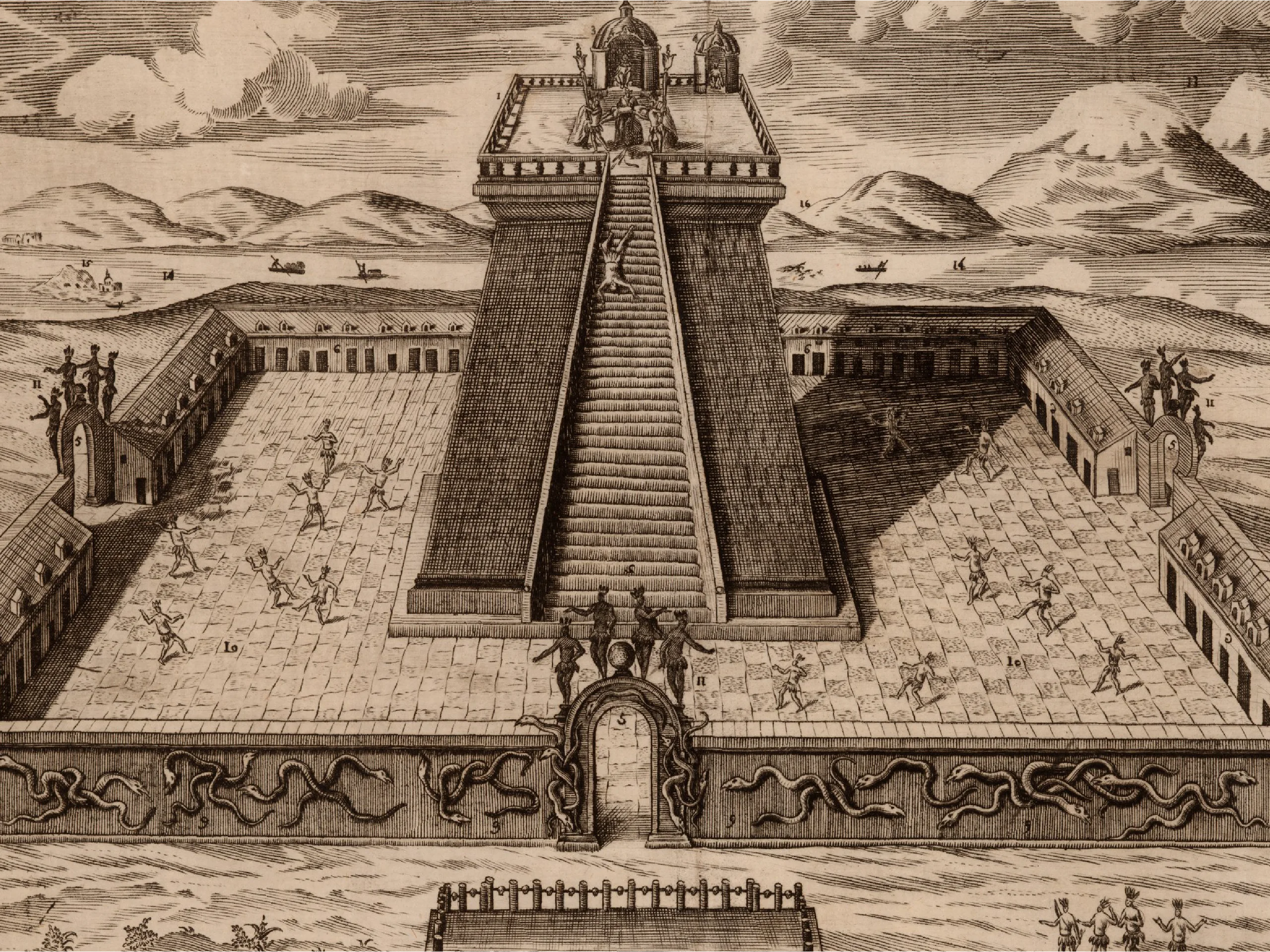
The Book in the Americas: The Role of Books and Printing in the Development of Culture and Society in Colonial Latin America (JCB Exhibition Catalogue)
As the celebration of the quincentennial of Columbus’s landfall approaches in 1992, we are reminded of the common heritage of the Americas and invited to reflect upon the accomplishments of the past that have shaped contemporary society. The history of the book in the former Spanish and Portuguese colonies of the New World, which today constitute countries of Latin America, is an important measure of human progress in the Western Hemisphere. The essential qualities of both the indigenous populations and the conquering nations are embodied in the literary culture of Latin America, and the study of the history of the book therefore provides clear evidence of the high level of their cultural achievements.
Columbus had not yet discovered America when Gutenberg began printing with movable type, but less than a hundred years after its invention, his technology was introduced into the New World by the Spaniards. In 1539, only twenty years after Hernan Cortes’s meeting with the Aztec chieftain, Moctezuma, the first book was printed in Tenochtitlan (or Mexico as the Spaniards called it). More amazing, however, is the fact that a form of the book had already existed in Mesoamerica for several centuries. The production of pictorial or ideographic manuscripts did not cease with the fall of Amerindian civilizations but became an early means of communication between friars and their native converts. From the valley of Anahuac to South America’s southern cone, the book accompanied the Spaniards, and they endeavored to establish its production wherever a clear need for it was expressed. By the end of their three- hundred-year domination of the Americas they had developed an entire network of presses throughout the viceroyalties, even in the dense continental jungles.
The history of the book in Brazil adds a dramatic chapter to this extraordinary story of human achievement in the New World. Despite the absence or suppression of the press during the early years of the colonial period, a single event, the Napoleonic invasion of the Iberian peninsula, transformed the history and culture of this Portuguese colony. With the arrival of the French on the outskirts of Lisbon, the royal court was transferred to South America, and with it came the government printing office to meet the needs of an exiled elite.
The exhibition was mounted originally for the conference on “The Book in the Americas” held at the John Carter Brown Library in June, 1987. Its purpose was to document not only the physical aspects of bookmaking but to illustrate as well the book’s role in society. In order to reconcile the broad scope of this project with the obvious constraints of space and time, the works on exhibit could only suggest the breadth and depth of the holdings of the John Carter Brown Library. Several extremely rare works were lent by the Sutro Library, and these are identified in the text of the catalogue; we are grateful for the assistance of Professor W. Michael Mathes, honorary curator of Sutro’s Mexicana collection.
The earliest examples of New World typography were the focus of the exhibition, and attention was given to the representation of diverse disciplines. Viewed as a whole, therefore, the display suggested the intricate mosaic of colonial Latin American society and culture, touching upon such pertinent topics as the transfer of European technology, the assimilation of the Indian, the growth of institutions of higher learning, the creativity of artists and writers, and the emergence of a national consciousness.
The Book and Printing in Spanish America
In many respects, 1492 was a crucial year for Spain. The conquest of the last Moorish kingdom in the Iberian peninsula and the expulsion of the Jews made possible the religious unification of a state that had achieved political solidarity just twenty-three years earlier with the marriage of Isabella of Castile and Ferdinand of Aragon. Columbus’s discovery of America, which became known in Europe in March 1493, offered the Spanish crown the ideal opportunity to maintain the exhilarating force it had gathered for the reconquest of the peninsula. The discovery also afforded Europeans a chance to begin again and to create a perfect world through careful planning and supervision. The task of building a new society from its foundations, however, proved to be a formidable undertaking, for the existence of large, sedentary Indian populations required the prudent and lengthy assimilation of American natives into the Spanish way of life.
The Catholic Church was instrumental in realizing the social and political goals of the Spanish crown in the New World. Augustinians, Dominicans, Franciscans, Jesuits, and members of other religious orders participated in the conversion of the Indians to Christianity, and as the earliest European educators, scholars, writers, and book collectors, they laid the groundwork for the continuous and stable growth of Spanish American society. Although their printing presses, institutions of higher learning, and libraries underwent gradual secularization, the Church’s influence on colonial life was constant and remained long after political changes had altered the course of the hemisphere’s history.
Apart from the clergy’s demands for vocabularies, grammars, and doctrinal works, the laity as well required the services of a press. Mexico City and Lima, with their viceregal courts and universities, were cultural and intellectual centers, and works of literature, history, music, and science were produced to meet the needs of an educated elite. The intelligentsia also sought immediate access to information, a desire that prompted the establishment of newspapers. During the independence movement, the efficiency and effectiveness of the periodical press made it an indispensable forum for nationalist expression.
The Audiencia of Mexico

Jean Gerson, and others
Tripartito del christianissimo y consolatorio doctor Juan Gerson de doct...
1544

Bartolomé de las Casas, and others
Regionum Indicarum per Hispanos olim devastatarum accuratissima descrpti...
1664-1598
Jacobo de Testera e.a.
[Catecismo Testeriano]
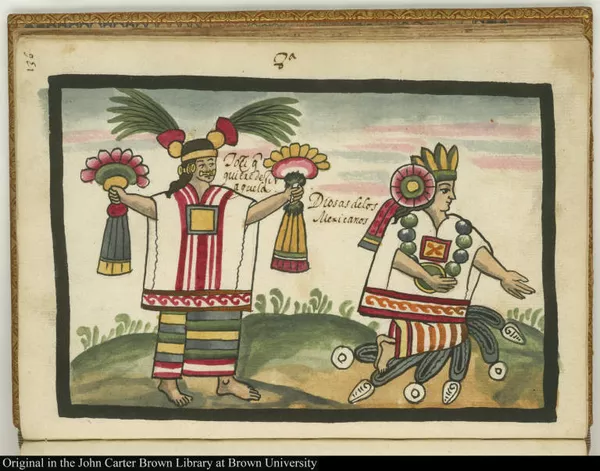


Nicolás Monardes, approximately 1512-1588, and others
Ioyfull newes out of the newfound world : wherein are declared the rare ...
1580-1577

Francisco Hernández e.a.
Quatro libros. De la naturaleza, y virtudes de las plantas, y animales q...
1615
Eusebio Francisco Kino, and others
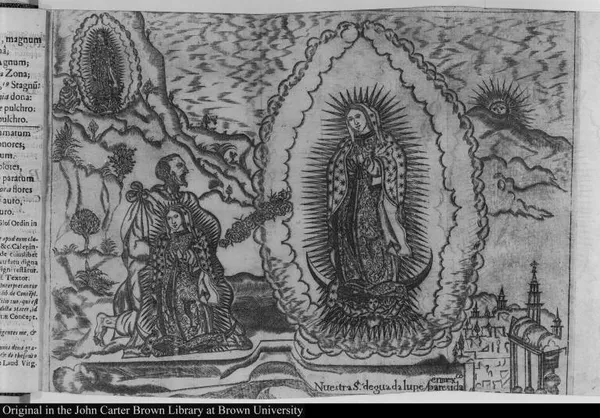
Exposicion astronomica de el cometa, que el año de 1680. por los meses ...
1681
Carlos de Sigüenza y Góngora, and others
Libra astronomica, y philosophica : en que D. Carlos de Siguenza y Gongo...
1690
The Captaincy-General of Guatemala

The Audiencia of Lima
Francisco de Xerez e.a.
Uerdadera relacion de la conquista del Peru y prouincia del Cuzco llamad...
1534
Alonso Narbona e.a.
Parte primera dela chronica del Peru

Miguel Suárez de Figueroa e.a.
Templo de N. grande patriarca San Francisco de la Provincia de los Doze ...
1675
Jacinto Calero y Moreira
Mercurio peruano de historia, literatura, y noticias públicas que da à...
1791-1795
The Captaincy-General of Chile


The Intendency of Paraguay
Antonio Ruiz de Montoya
Señor. Antonio Ruiz de Montoya de la Compañia de Iesus, y su procurado...
1639-1640


The Intendency of Buenos Aires
José Antonio de San Alberto e.a.
Carta circular, ò edicto, de el ilustrisimo, y reverendisimo señor D. ...
1781
The North American Borderlands

Alvar Núñez Cabeza de Vaca, active 16th century, and others
La relacion que dio Aluar Nuñez Cabeça de Vaca de lo acaescido en las ...
1542
Carlos de Sigüenza y Góngora e.a.
Description, que de la vaia de Santa Maria de Galve (antes Pansacola) de...
1720

Compañía de María Santísima de la Enseñanza de México, and others
Relacion historica de la fundacion de este Convento de Nuestra Señora d...
1793
The Viceroyalty of New Granada
The Captaincy-General of Cuba
The Captaincy-General of Venezuela
The Book and Printing in Portuguese America
Numerous factors distinguish the pattern of colonization in Brazil from that of the territories conquered by the Spanish in the New World. Although strategic and religious considerations were important, the Portuguese established a colony in South America primarily because they wished to tap the region’s economic potential. Various kinds of tropical wood attracted entrepreneurs to the Brazilian coast, and it was hoped that the demand for this commodity might replace a declining trade with India.
In addition to developing a thriving lumber industry, the Portuguese carved large plantations, or fazendas, out of the wild Brazilian forest, on which they produced rice, sugar, and other agricultural products for export. These plantations, rather than the towns and cities, became the early centers of colonial society. Indian civilizations, such as those found in Peru and Mexico, did not exist in Brazil, and the Portuguese colonists sought to enslave rather than assimilate the scattered tribes they encountered.
The pattern of colonization in Brazil and the character of the Indian population influenced the early development of printing and bookmaking there. It was difficult to govern a sparse, widely-scattered, often illiterate population dependent for the most part on the powerful landowners. As a result, relatively few books were imported, and the authorities believed that a printing press in the colony might threaten the established order. Brazil did not support a flourishing printing and publishing enterprise until external circumstances transformed Rio de Janeiro into the capital of the empire.
By the beginning of the eighteenth century, substantial urban populations were developing, and Salvador da Bahia was the second largest city in the Portuguese empire, after Lisbon. In 1807, when Napoleon’s troops invaded the Iberian peninsula, the Portuguese court and bureaucracy, with the help of the English, were able to escape capture by fleeing to Brazil and bringing with them the principal instruments of government.
As the French army advanced on Lisbon, the National Library was placed on board ships waiting in the harbor. Printing equipment, if not loaded aboard then, was soon acquired by Prince Regent João’s government-in-exile. In 1808, the Royal Printing Office was established, and Brazil’s first newspaper, the Gazeta do Rio de Janeiro, was published the same year. Although the Portuguese government returned to Lisbon in 1821, the cultural and intellectual activity stimulated by the court’s presence did not cease. On the contrary, it grew with the output of the press, contributing to the formation of opinion leading to Brazil’s declaration of independence the following year.
Brazil
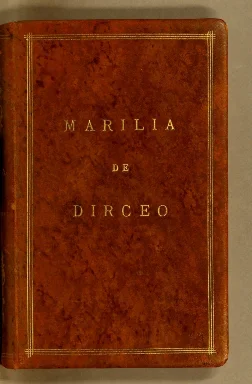


Luis António Rosado da Cunha
Relaçaõ da entrada que fez o excellentissimo, e reverendissimo senhor ...
1247-1747

Codigo Brasiliense
1811-1822
Manuel Ferreira de Araújo Guimarães
Elementos de astronomia par uso dos alumnos da Academia Real Militar
1814
Credits
Curated by Julie Greer Johnson, with a bibliographical supplement by Susan L. Newbury
Items Pending Integration
During the migration of our legacy catalogs and past exhibitions into Americana, there are occasionally items that cannot be immediately included in our new environment. This may happen for two reasons: the item in question is not yet cataloged, or it was lent by another institution.
Any items that are not integrated into Americana are included in this section and added to our processing queue.
Gabriel Biel (d. 1495). Repertorium generate & succinctum: vern[m) tame
\ valde utile atq[ue\ necessariu\m ]: contentoru[m\ in quatuor collectoriis , acutissimi ac profundissimi theologi Gabrielis Biel super quatuor libros sententiarum. Lyon, 1527.
LENT BY THE SUTRO LIBRARY, SAN FRANCISCO.
This treatise on the Gospels belonged to Fray Juan de Zumárraga’s personal library, which contained more than four hundred volumes at the time of his death in 1548. The tide page (fig. 2) bears his signature.
Miguel de Medina (1489-1578). De sacrorum hominum continentia libri v. Venice, 1569.
LENT BY THE SUTRO LIBRARY, SAN FRANCISCO.
As an important educational center in New Spain, the Colegio Imperial de Santa Cruz at Santiago Tlatelolco attracted numerous scholars, who consulted the many volumes of its extensive library. This theological work (fig. 3), once in the Colegio’s library, bears the signature of the Franciscan missionary Fray Juan Baptista and was designated for his use only {ad usurri). Because he was a member of a mendicant order, he was not permitted to own any personal property.
Fray Juan Baptista, who was born in New Spain, entered the Franciscan Order at the great convent of Mexico and taught philosophy there. He spent his later years at Tlate¬lolco, where he served as guardian and be¬ came one of the leading authorities on the Nahuad language.
Between 1599 and 1601, his well-known Confessionario en lengua mexicanay castellana and several other bilin¬ gual works were printed at the Colegio by Melchor Ocharte.
In 1536, the book was presented to the first European academic library in the Americas, established in the Colegio Imperial de Santa Cruz at Santiago Tlatelolco. During his stay in Spain (1532-1534), Zumarraga’s petitions to the crown led to the foundation of the Colegio, one of the earliest institutions of learning in the New World.
New Spain. Ordena[n]ças y copilacion de leyes: hechas por el muy illustre senor don Antonio d[e] Me[n]doça Visorey y Govemador desta Nueva Espana: y Preside[n]te de la Audie[n]cia Real q[ue] en ella reside: y por los Senores Oydores d[e] la dicha audie[n\]cia:p[ar]a la bue[n]a governacio[n] y estilo d[e] los oficiales della. Mexico, 1548.
LENT BY THE SUTRO LIBRARY, SAN FRANCISCO.
In addition to producing religious materials, Juan Pablos also published a number of secular works. Among them was the Ordenanças, the first law book printed in the New World. It was compiled by the first Viceroy of New Spain, Antonio de Mendoza, who served in that post from 1535 to 1550. In the latter year he was appointed Viceroy of Peru, where he served until his death in 1552.
This sixteenth title issued by the first American press is an extraordinary example of early Gothic-letter typography (fig. 6). Only two copies are known to exist: this one from the Sutro Library which was originally a part of the library at the Franciscan monastery of Texcoco, and the one in the Lenox Collection of the New York Public Library. The laws included in the Ordenanças were later incorporated into the better-known Pbilippys Hispaniarum et Indiarum Rex, compiled by Doctor Vasco de Puga (who served as a judge on the Audiencia of Mexico) and printed in 1563 by Pedro Ocharte, Mexico’s third printer.
Sister Juana Ines de la Cruz (1648-1695). Villancicos. Mexico, [1677].
Sor Juana Ines de la Cruz, whose brilliant literary career as a poet, prose writer, and playwright won her the title of the “Tenth Muse,” composed numerous poems for religious festivities in Mexico. Among them are her villancicos, or church carols sung on Catholic feast or saints’ days. Although the musical notations for these pieces were not recorded, the lyrics were printed especially for the occasion. When they published villancicos, printers usually followed the small quarto format and placed a woodcut of the Virgin or the saint being honored on the title page (fig. 31). This particular song, written in praise of Saint Peter, is a blend of elements of Mexican culture with aspects of Catholic ritual. In the “Enzalada,” one of the composition’s intercalated poems, a mestizo comes forth to express his sentiments toward this holy man (fig. 32).
No other copy of the villancico to Saint Peter is known to be in the United States
Mexico. Decreto constitucionalpara la libertad de la America mexicana: sancionado en Apatzingan a 22 de octubre de 1814. Apatzingan, [1814].
LENT BY THE SUTRO LIBRARY, SAN FRANCISCO.
Although the movement for independence in New Spain was begun by Father Miguel Hidalgo y Costilla at Dolores in 1810, a concrete plan for an independent state was not formulated until 1813. At that time, the Acta de Independencia was drawn up and signed at Chilpancingo. A constitutional congress then drafted an organic law for the creation of a new nation. The twenty-two articles of the Decreto constitucional established a Catholic, egalitarian, and sovereign state free to elect the form of government most suited to its citizens. Military pressure by royalist troops forced the constitutional congress and its press to move from place to place throughout the modern states of southern Michoacan and northern Guerrero. Finally, at Apatzingan on October 22, 1814, the Constitution was signed by Jose Maria Liceaga, Jose Maria Morelos, Jose Maria Cos, and Remigio de Yarza.
The printed copy of the Constitution from the Sutro Library, dated October 24, 1814, includes the rubricas (individual flourishes similar to initials) of the four signers (fig. 45). It is the only copy reported to be held by a collection outside of Mexico.
Original Catalogue

Julie Greer Johnson, and others
The book in the Americas : the role of books and printing in the develop...
1988
Project Creator(s)
- The John Carter Brown Library